
The Best Mold Remediation in Gettysburg PA
Mold Remediation for Fieldstone Cellars, Split-Level Basements, and New Subdivisions in Gettysburg Borough, Cumberland Township, and Straban Township
Our shop is at 498 Wye Alley, so Gettysburg is the one place we are never more than a few minutes from. This page is everything we know about how mold gets into Gettysburg houses, backed by Census, NOAA, county, and state sources, plus what we do about it.
Mold Remediation in Gettysburg, Start to Finish
Gettysburg Mold Remediation Pros is a locally owned mold inspection, mold removal, and water damage company on Wye Alley in Gettysburg Borough. Chuck Dalem started it in 2012 after years running water damage jobs for a national restoration franchise, where he saw too many walls go up over damp framing. We still do it the other way. Find the water. Contain the work area. Take out what has mold growing on it. Dry the framing to standard. Then close it up.
That is the short version of how we handle every house in Gettysburg, Cumberland Township, and Straban Township. The rest of this page is the long version, and most of it is about the houses themselves. Mold follows moisture, and moisture follows the age of the house, the ground it sits on, the weather it gets, and how the water gets in and out of the property. We pulled the numbers from Census data, NOAA weather records, Adams County soil mapping, the county hazard plan, and the borough code so you can see where each fact comes from.
If you would rather skip the reading, call (267) 828-9088. If you want to see what we do before you call, start with mold removal, then come back here for what is specific to Gettysburg.

What You Can Call Us For in Gettysburg
Most of our Gettysburg calls fall into a handful of buckets. Each one has its own page with the full process, and here is how they map to what you are probably looking at right now.
- A smell, stain, or spot you are unsure about. Start with a mold inspection: moisture readings, thermal imaging, and written findings.
- Growth you can see. That is mold removal: containment, HEPA filtration, removal, cleaning, and drying.
- A basement that smells every summer. Basement mold removal covers fieldstone, block, and finished lower levels, from the wall up.
- A dirt-floor crawl space. Crawl space mold removal, with any encapsulation priced and scoped on its own line.
- Dark staining on roof boards. Attic mold is almost always a ventilation problem first, then a job of cleaning the wood.
- A bathroom that never fully dries. Bathroom mold removal, including the fans that never vent outside.
- A flood, burst pipe, or wet ceiling. Water damage and drying works best when it starts inside the first two days.
- Dark growth called black mold. Black mold removal explains why color alone does not identify a species.
- Musty air when the HVAC runs. Air duct mold cleaning and indoor air quality. Shops and offices: commercial.
What Happens When You Call
The process does not change with the ZIP code. What changes is where we look first. Every job runs to the ANSI/IICRC S520 standard for professional mold remediation, and we hold IICRC AMRT and WRT certifications.
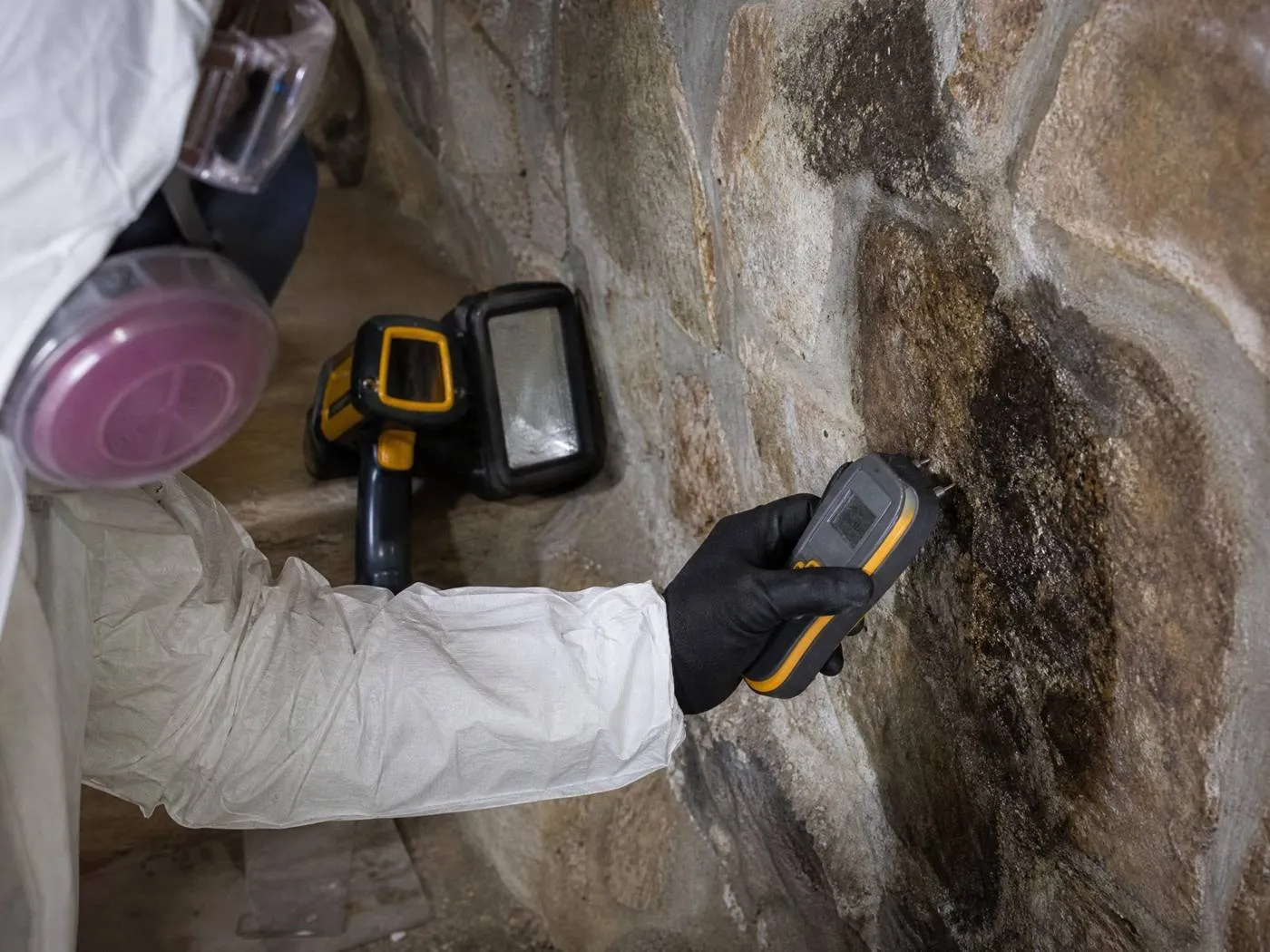
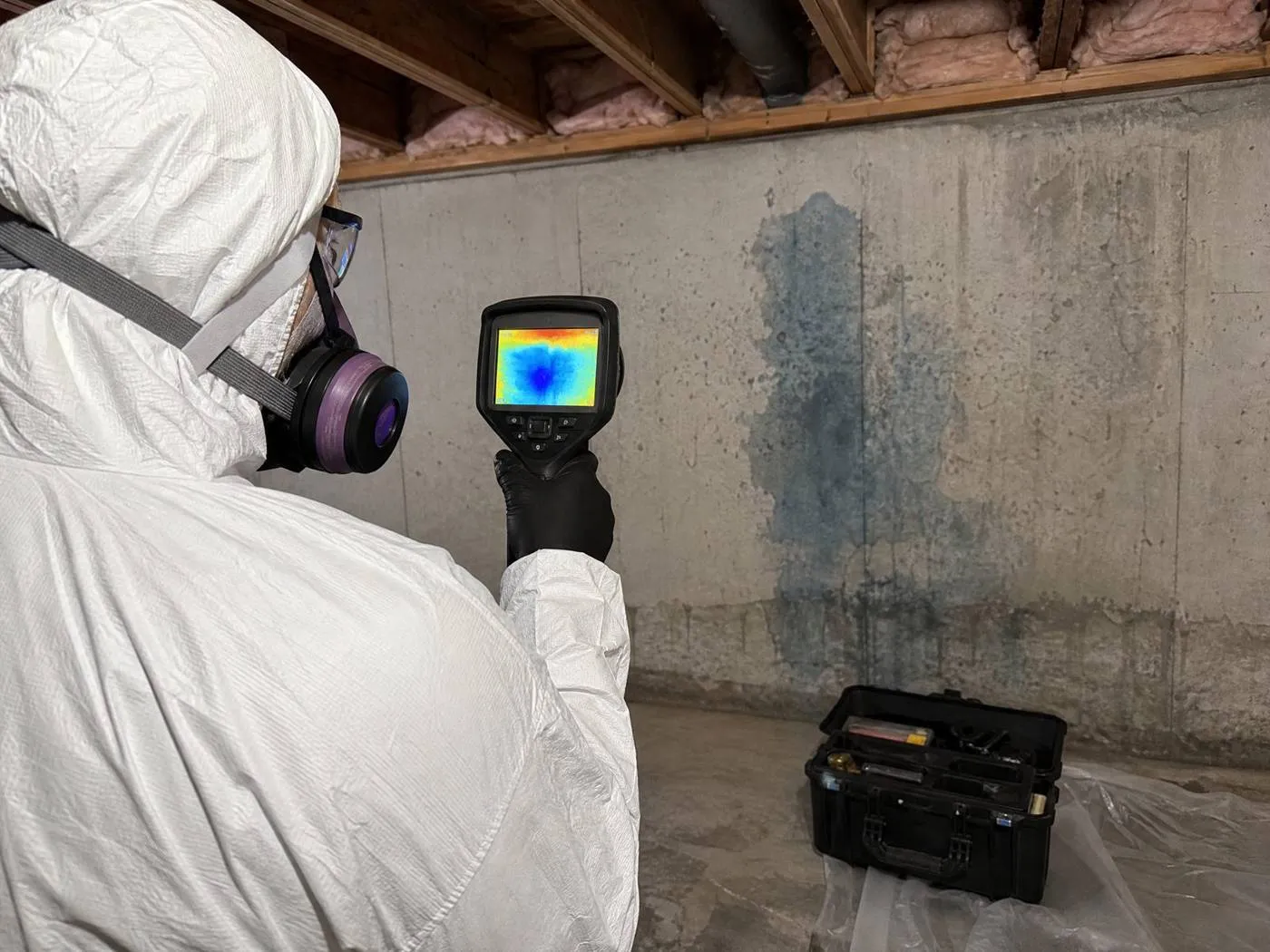
- We find the water. Moisture meter, thermal camera, and a walk of the house inside and out. If the source is still active, nothing else works.
- We write the scope. In writing and before work starts: what comes out, what gets cleaned, what it costs, and what is not included.
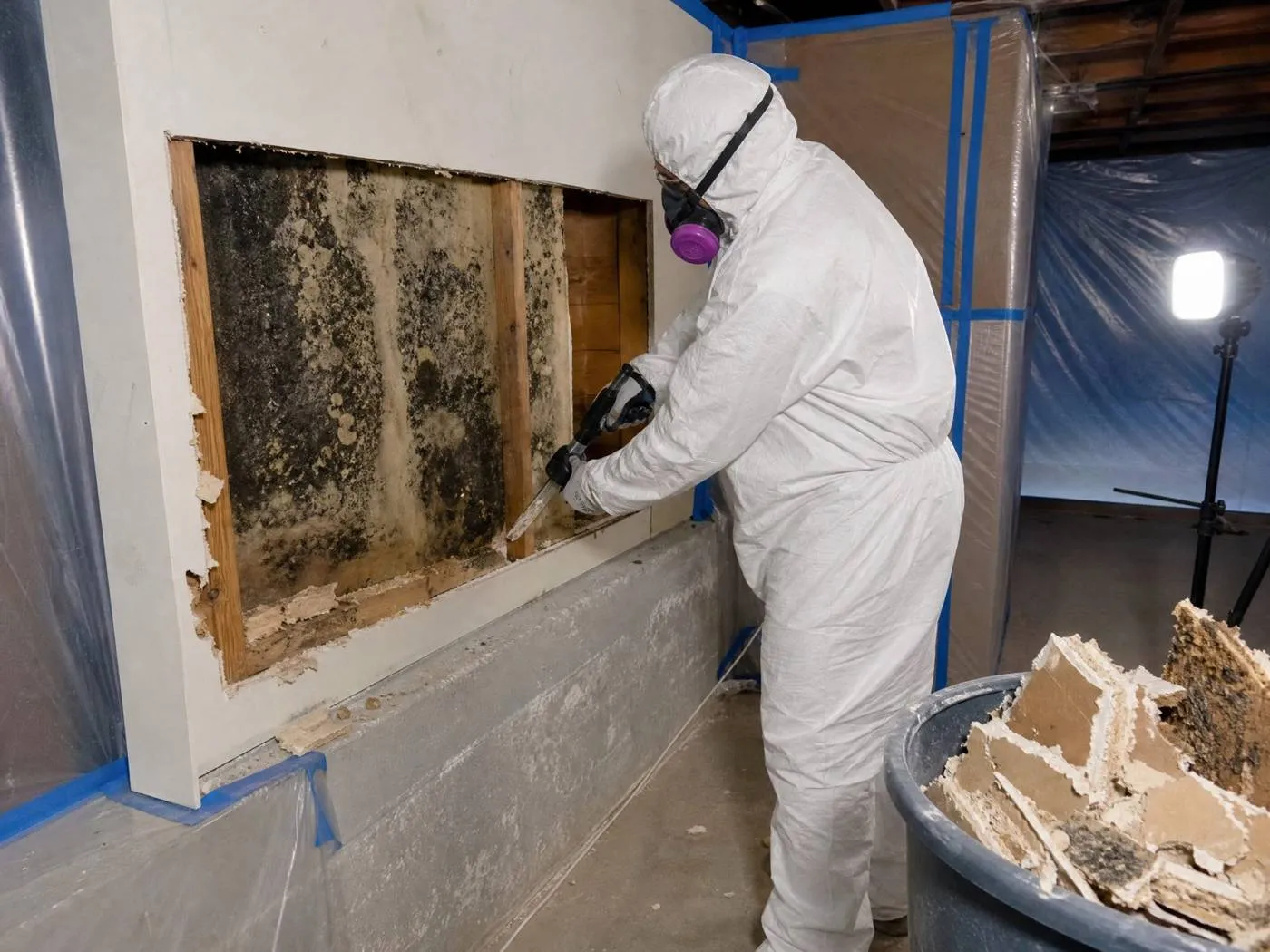
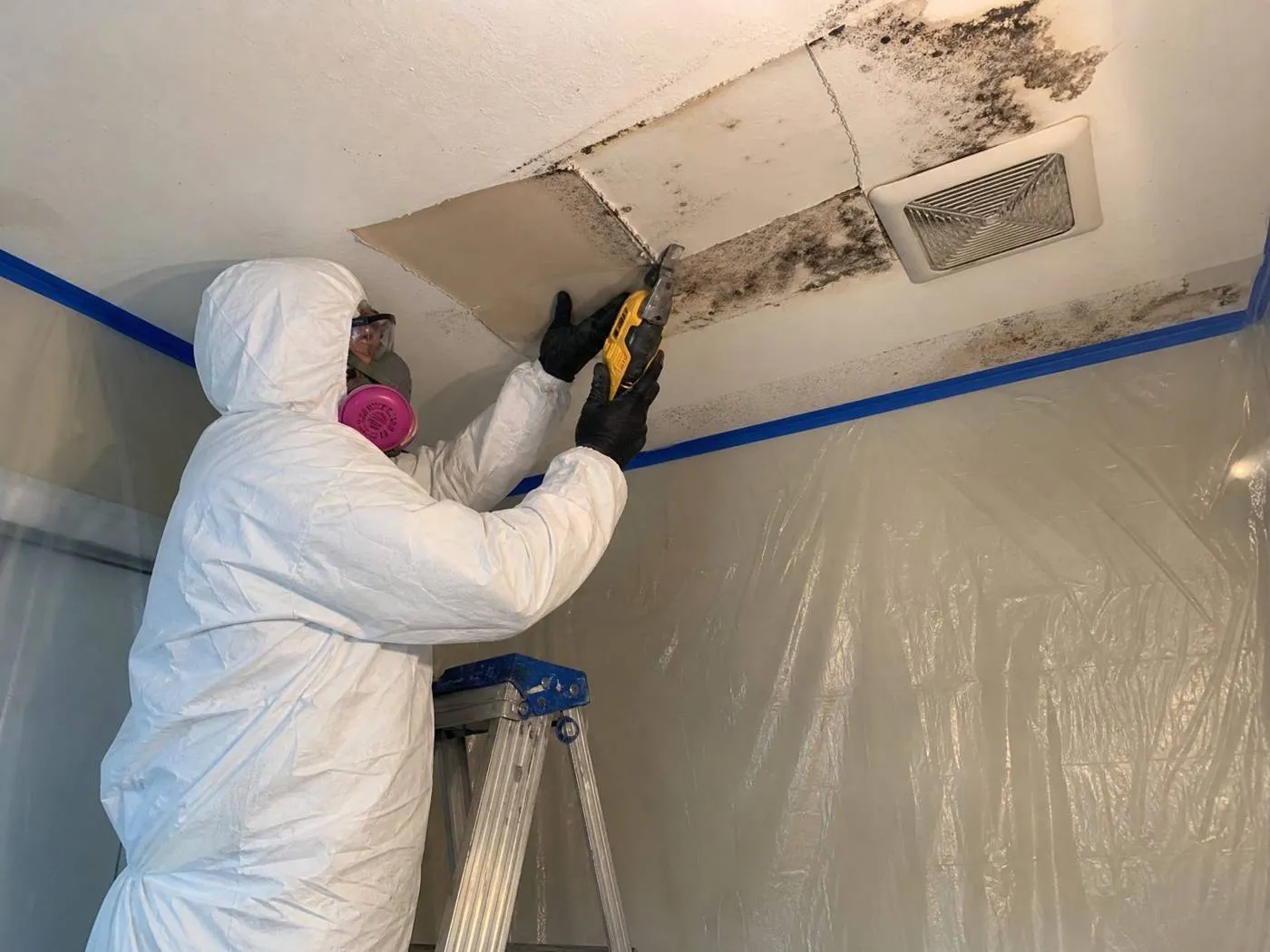
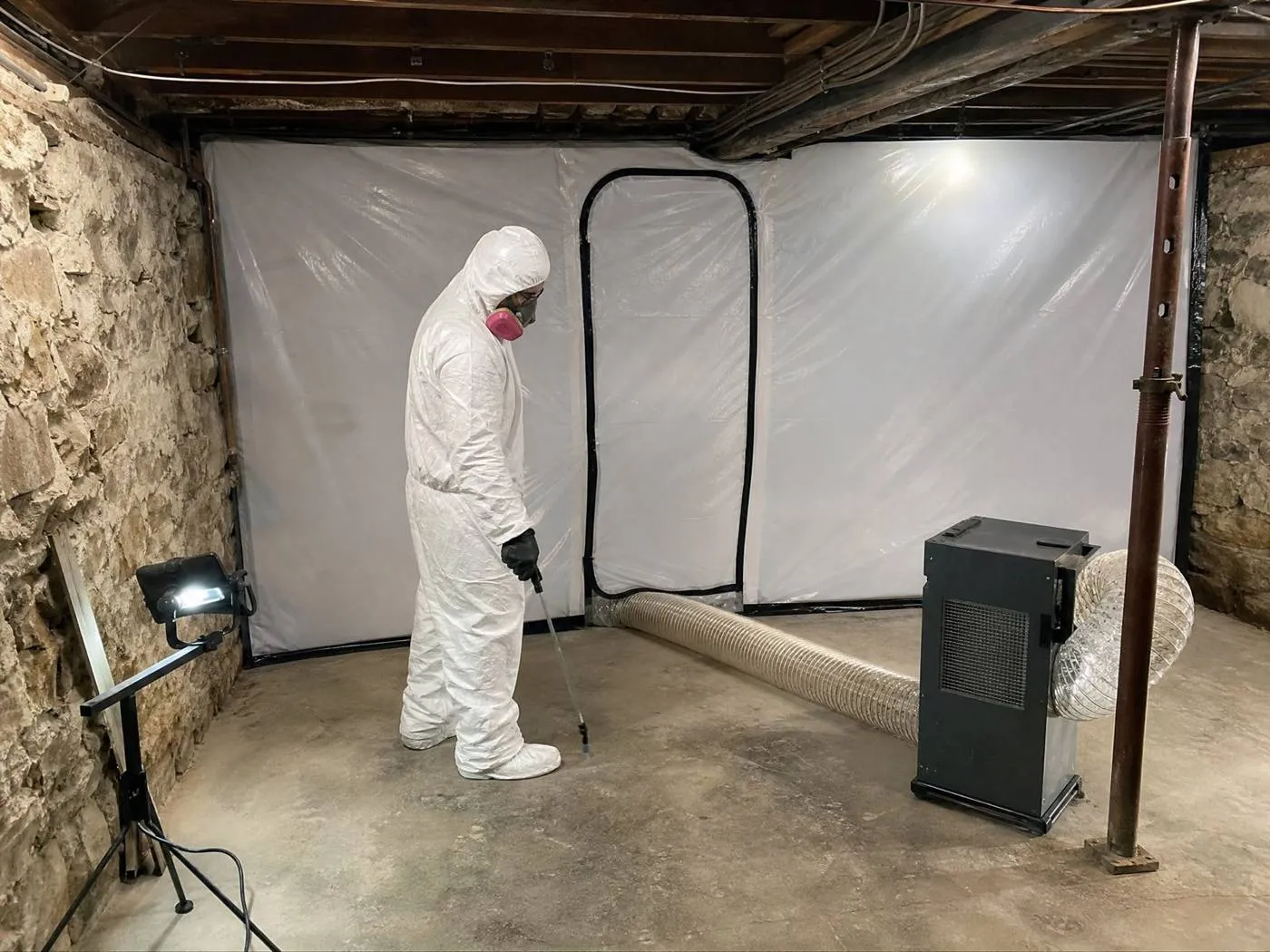
- We contain the area. Plastic barriers, negative air, and a HEPA air scrubber, so cutting into a wall sends no spores through the house.
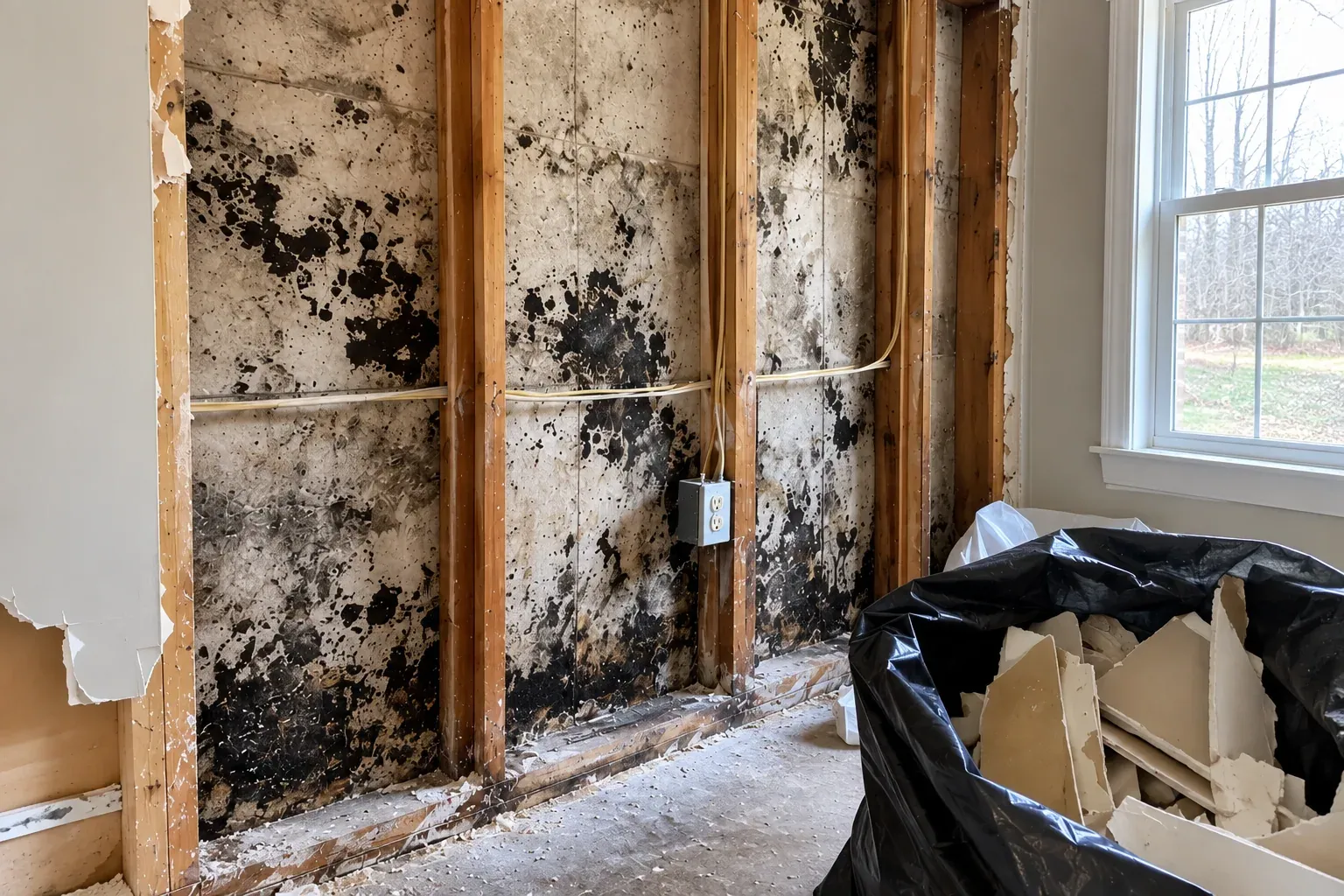
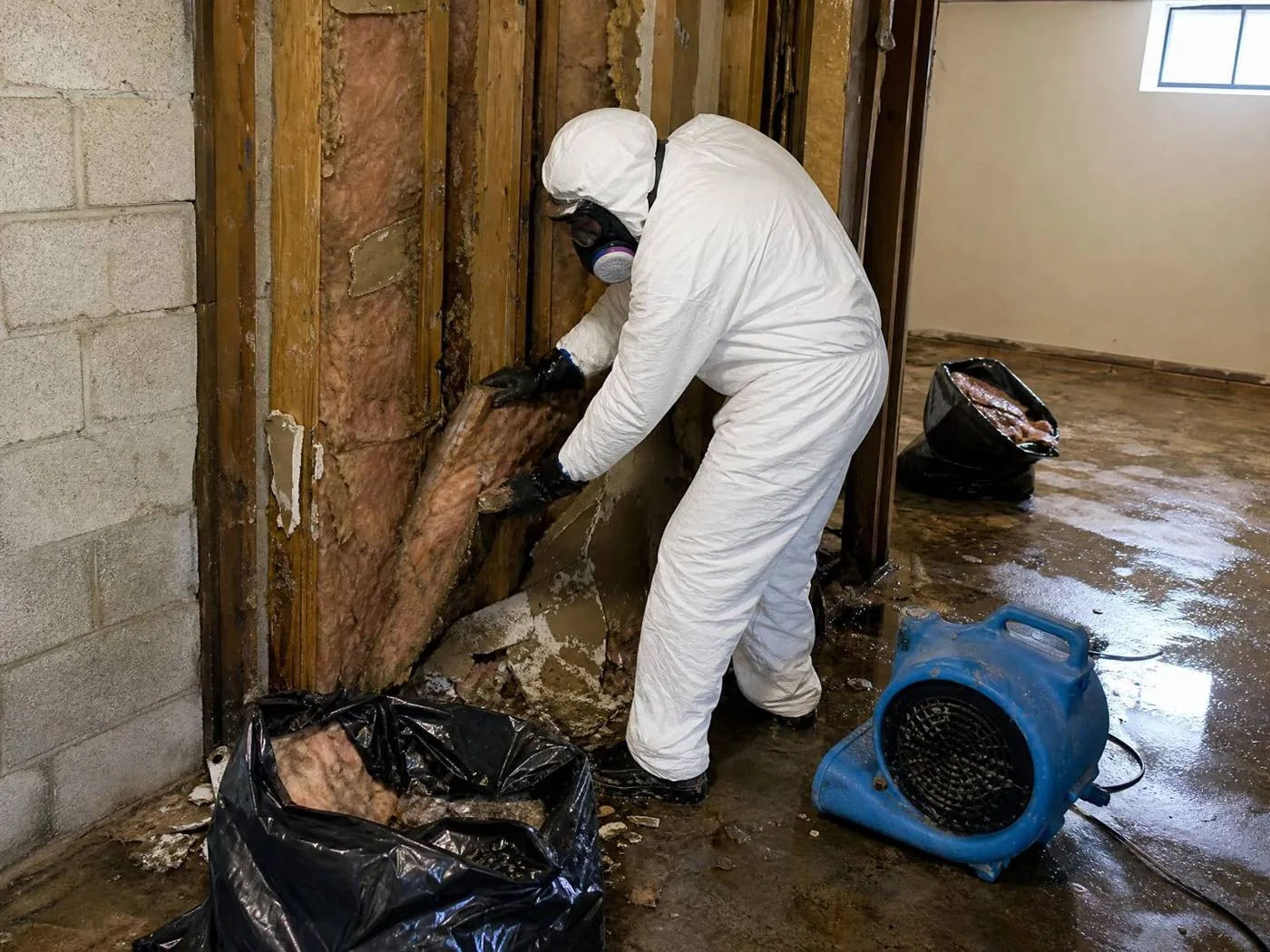
- We remove what is growing. Drywall, insulation, and padding with growth come out in sealed bags. We never fog it, paint over it, or spray and hope.
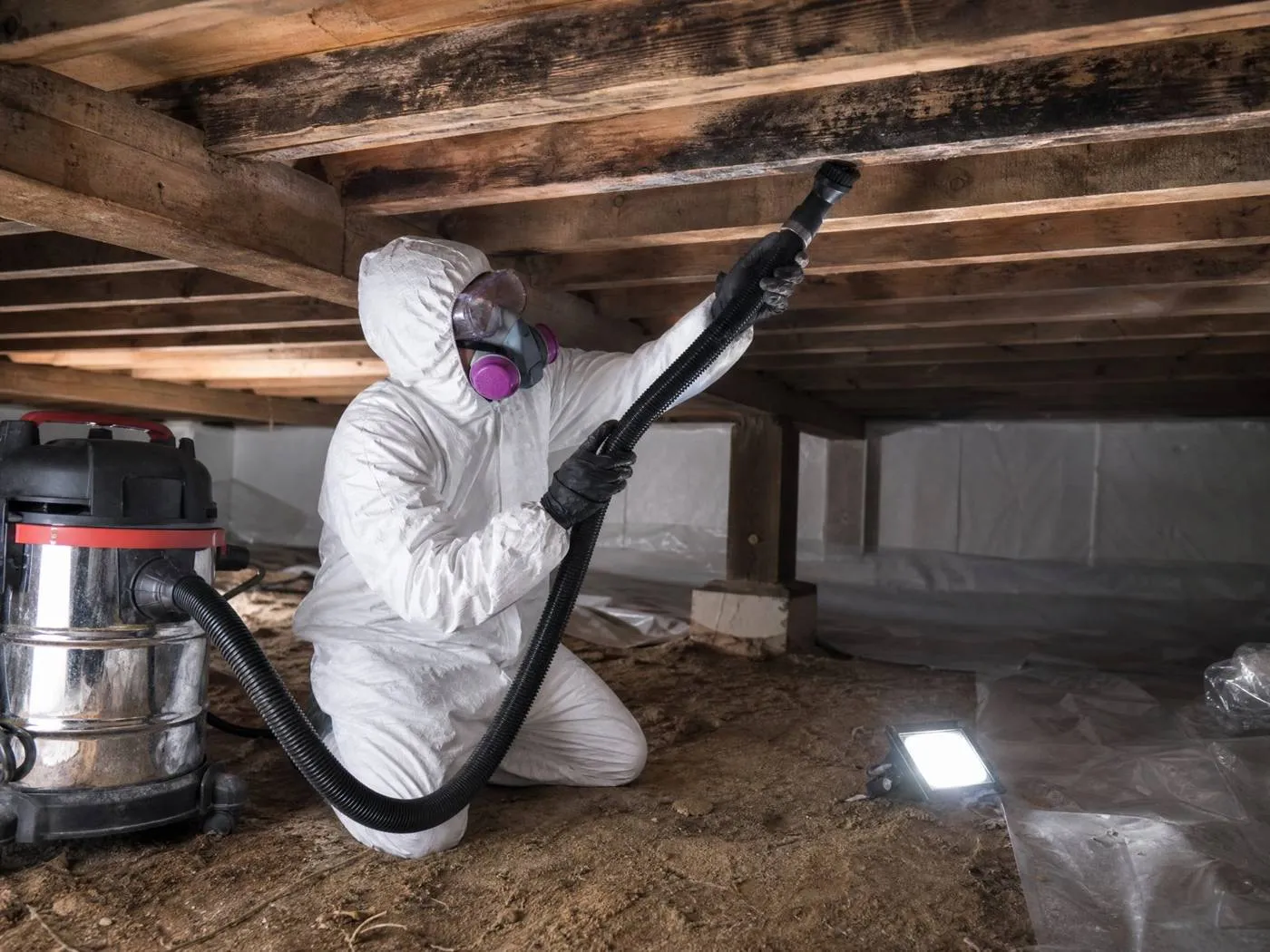
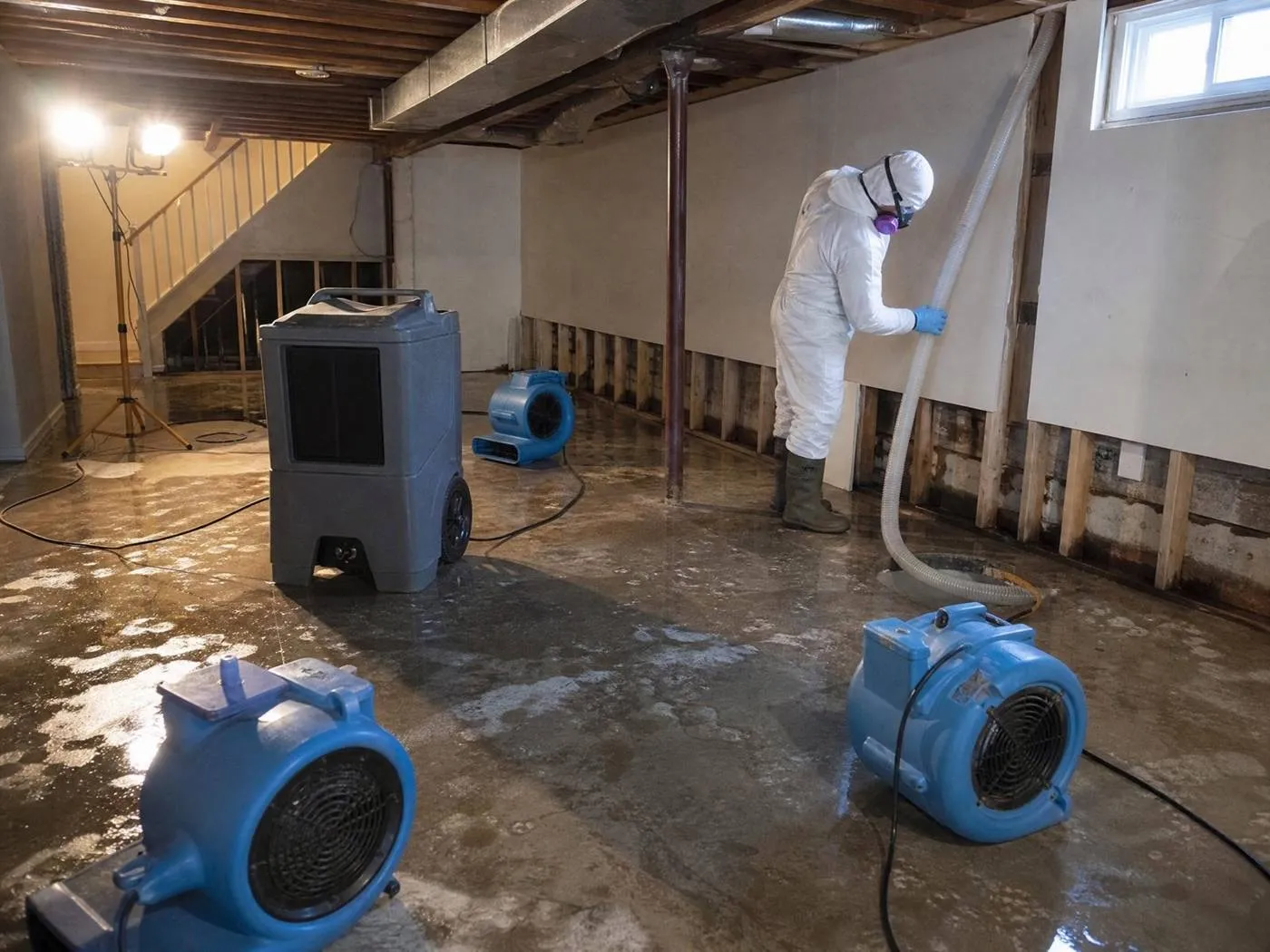
- We clean and dry. HEPA vacuuming, wire brushing of salvageable framing, then air movers and dehumidifiers until the meter reads dry.
- We verify and close. Final moisture readings and photos go in your job file, and independent clearance testing is welcome. Then repairs go back in.
Every residential job carries a one-year warranty. The full walkthrough, with photos, is on our mold removal page.
What Mold Remediation Costs Around Gettysburg
Typical planning ranges for homeowners in the Gettysburg area, based on current published remediation costs. These are not quotes. Your price comes after the inspection and depends on what’s affected, access, containment, the moisture source and any repairs.
| Item | Typical planning range |
|---|---|
| Mold inspection: visual check, moisture readings, thermal imaging when useful, written findings and scope | $300 to $500 |
| Air sampling, 3 to 5 samples with a lab report | $300 to $700 |
| Clearance testing after remediation, when needed | $250 to $500 |
| Small or localized professional remediation | $500 to $1,500 |
| Typical remediation project | $1,500 to $6,000 |
| Bathroom mold | $500 to $2,000 |
| Basement, partial or localized | $1,500 to $6,000 |
| Basement, extensive or full | $6,000 to $15,000+ |
| Crawl space, typical | $1,500 to $4,000 |
| Crawl space vapor barrier, basic (separate from remediation) | $1,500 to $4,000 |
The ranges come from 2026 cost data published by HomeGuide and Angi. What moves a Gettysburg price is the same as anywhere. How much area is affected, whether drywall or flooring has to come out, access, how much containment the job needs, whether the water was clean, and how long it sat. In older borough houses, access in tight stone cellars and the need to fix the moisture source add to the scope. In newer homes it is usually the repair after removal.
The full breakdown for attic, ducts, whole-house, and water damage is on our mold removal cost page.
Smell it, see it, or just not sure?
How You Know the Job Is Done
The invoice says the mold is gone. How do you check? The EPA’s homeowner guide gives a plain list, and none of it starts with a lab number.
- The water problem is fixed. The EPA says you must have completely fixed the water or moisture problem before cleanup or remediation can be considered finished. A job that cuts out stained drywall and leaves the leaking line behind has not passed anything.
- No visible mold and no moldy smell. The EPA says visible mold and moldy odors should not be present.
- A revisit shows nothing new. The EPA says you should have revisited the site shortly after cleanup and it should show no signs of water damage or mold growth.
- No coating over it. The EPA says do not paint or caulk moldy surfaces. If a crew wants to spray a sealant before the final check, ask to see the bare wood first.
There is no government pass-or-fail number for mold spores in a home, so a lab report cannot grade a job against one. Air samples, when they are taken, are a cross-check after the visual and moisture checks, not a replacement for them.
Pennsylvania does not license mold companies and has no clearance rule, so the same company can inspect, remove, and declare the job finished. On a small, visible job that is often fine. On a large job, or one tied to a home sale, you can write the checks into the contract: named clearance criteria, final moisture readings, before and after photos, and the right to bring in your own inspector. We welcome that on every job. The full comparison, including how states that do regulate mold handle it, is in our guide on how to know mold remediation worked.
Do You Need a Mold Test First?
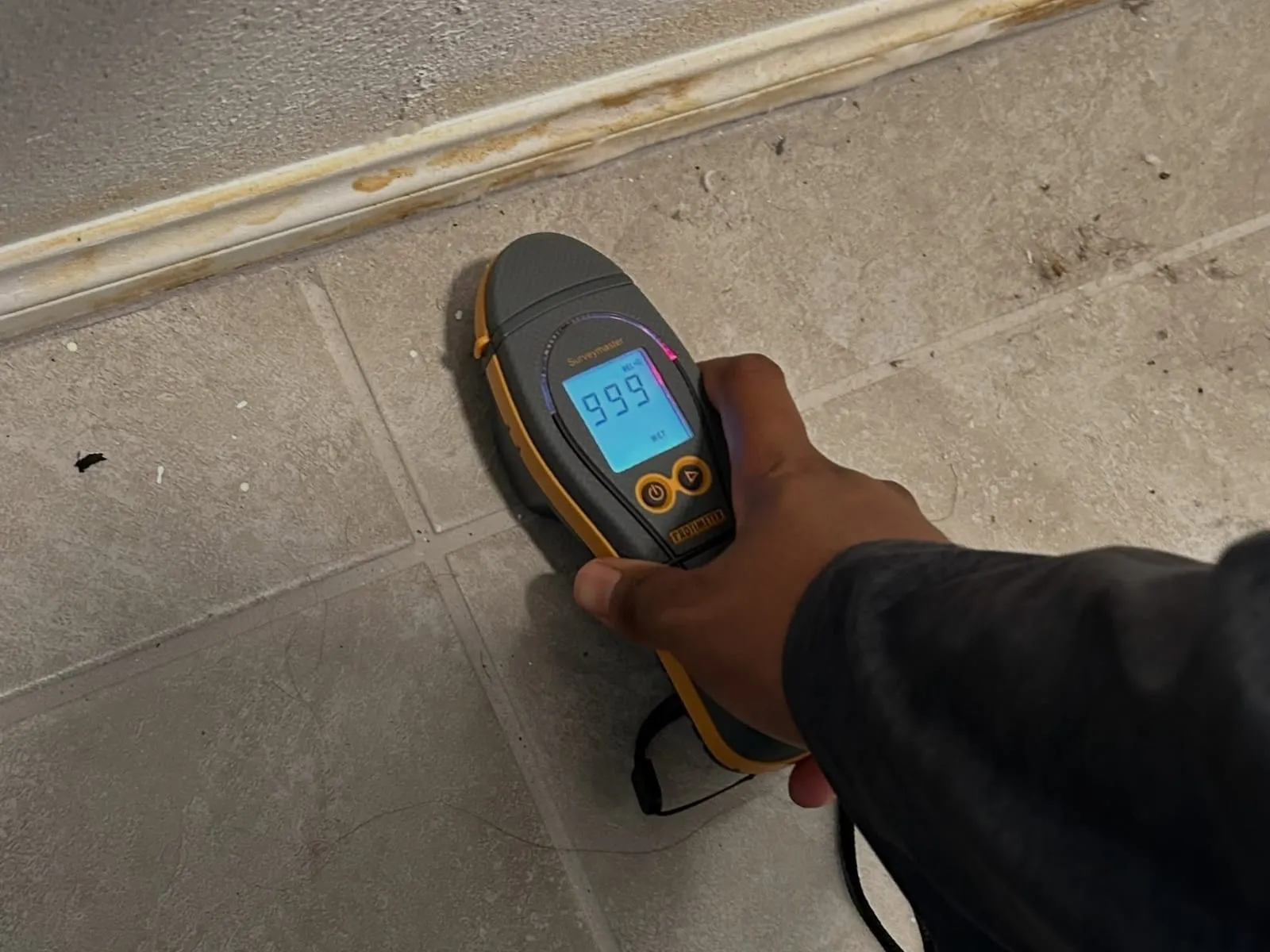
Often, no. The EPA says that if you can see mold, sampling usually is not needed, and the CDC does not recommend routine mold testing because there are no standards for an acceptable level in a home. You also do not need to know the species. The response is the same: fix the moisture, remove the growth.
A test makes sense in a few cases. You smell something and cannot find it. You need documentation for an insurance claim or a home sale. You want independent confirmation that a job is finished. Or you are trying to decide whether there is hidden growth in a wall.
We say plainly when a test will not change the plan. Our mold inspection starts with a visual check, moisture readings, and thermal imaging, and we only add air or surface sampling when it answers a real question. Be careful with home test kits. They tell you mold spores exist, which is true of every house, and not whether you have a problem. Our mold inspection and testing page has the details, and the guide on how to read mold test results helps if you already have a report in hand.
If we both inspect and remediate, you should know that is a conflict of interest some states restrict. Our answer is to be upfront about it. You can bring in a third party for clearance anytime, and we will work to their scope.
Will Insurance Pay for Mold Remediation?
It depends on why there is mold. Mold that follows a sudden, covered event, like a burst pipe or a failed water heater, is sometimes covered, often with a cap on mold. Mold from groundwater, seepage, humidity, or a slow leak is usually excluded. Flood is a separate policy.
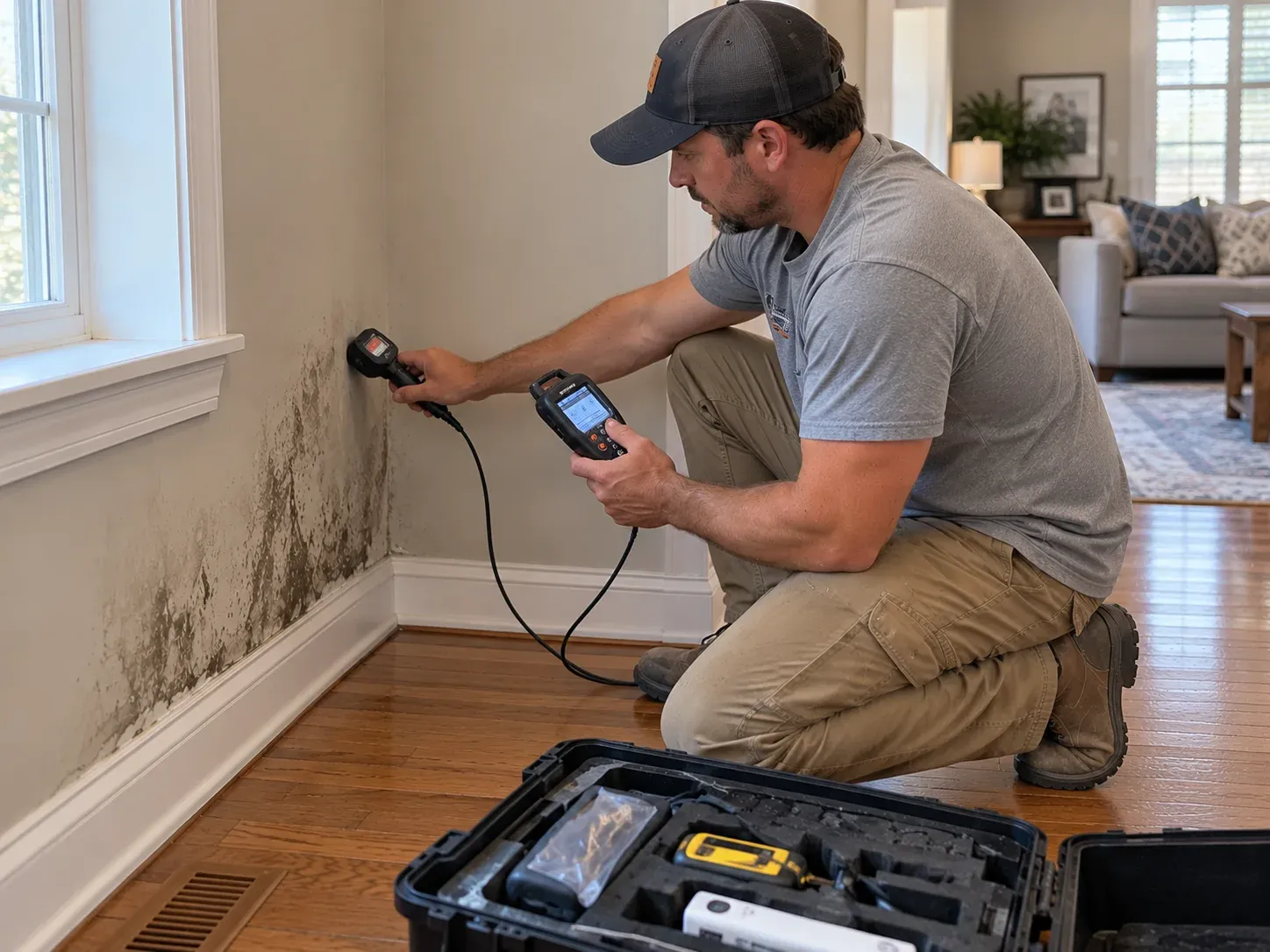
What helps your claim: speed, and paper. Call your insurer as soon as you find the problem. Ask specifically whether mold is covered under your circumstances. Take photos before anything is moved. Keep wet material until the adjuster has seen it if they ask. Get the scope and price in writing before work starts.
We document everything with moisture readings, photos, and a written scope, so the adjuster has what they need. We do not promise coverage, and we cannot tell you what your policy says. Read your declarations page or call the agent. If a company promises to “handle the insurance” and guarantees payment, be cautious.
Gettysburg Housing by the Numbers
The single biggest predictor of what we find in a house is when it was built. The table below comes from the Census Bureau’s American Community Survey, 2020 to 2024 five-year estimates, pulled through Census Reporter. It compares Gettysburg Borough, the two townships that wrap around it, and Adams County as a whole.
| Measure | Gettysburg Borough | Cumberland Township | Straban Township | Adams County |
|---|---|---|---|---|
| Housing units | 2,801 | 3,070 | 1,995 | 43,672 |
| Built before 1940 | 47.5% | 5.2% | 12.5% | 17.5% |
| Built before 1980 | 87.2% | 46.2% | 50.9% | 49.5% |
| Median year built | 1942 | 1983 | 1979 | 1980 |
| Built 2000 or later | 5.3% | 29.7% | 22.9% | 22.3% |
| Renter-occupied | 53.3% | 23.1% | 13.5% | 21.1% |
Two things jump out. The borough is far older than the county around it. Nearly half of the borough’s homes were built before 1940, against about one in six countywide. And the growth since 2000 has gone almost entirely into the townships. That means a single Gettysburg mailing address can mean a 1850s brick rowhouse, a 1975 split-level, or a house finished last year, and the three do not fail the same way.
Source: U.S. Census Bureau, American Community Survey 2020 to 2024 five-year estimates, via Census Reporter.
Four Kinds of Gettysburg Houses, Four Kinds of Mold Calls
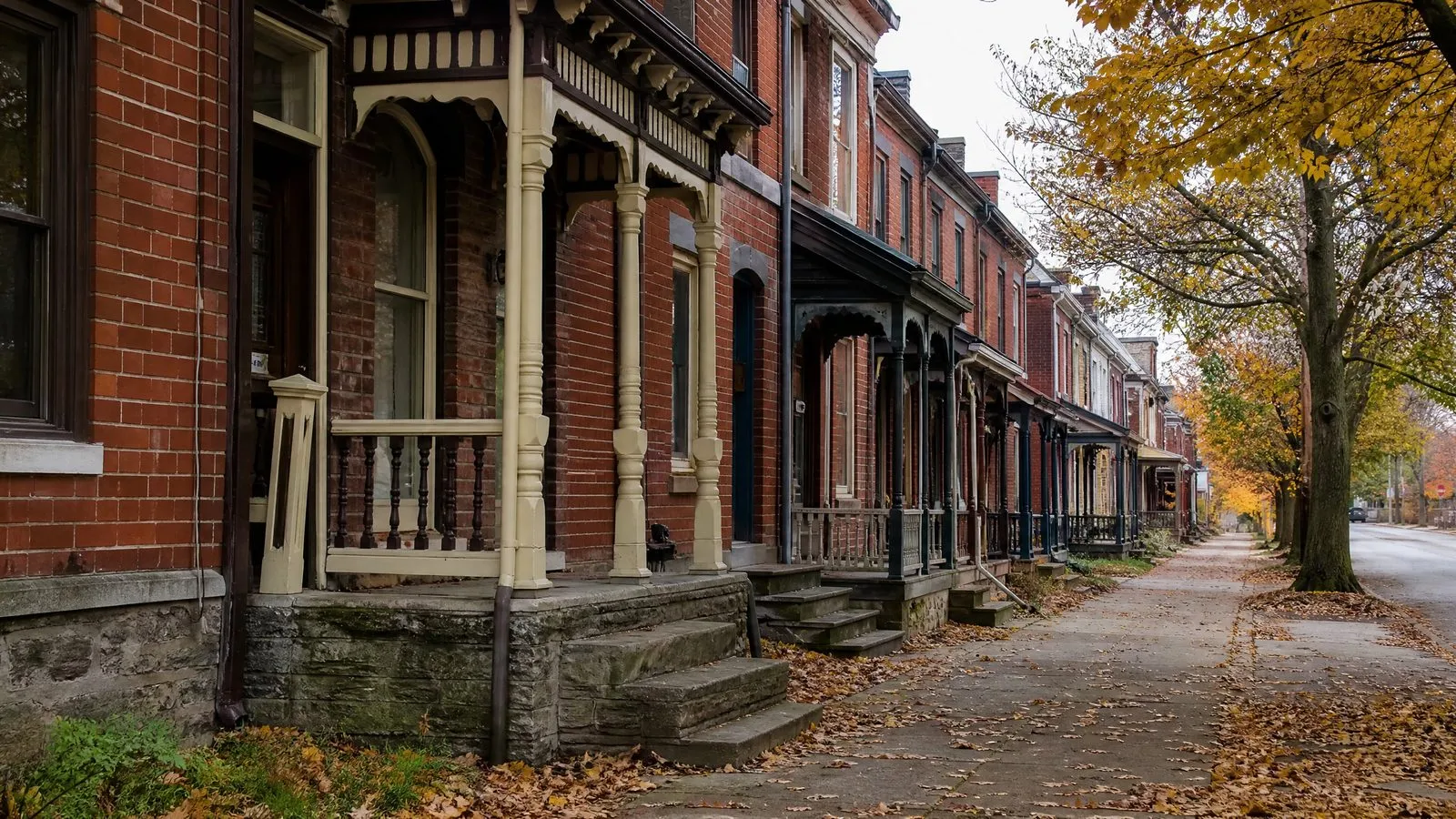
The borough core, built before 1940. Brick and stone rowhomes around Lincoln Square, many on fieldstone or early brick foundations with cellars never meant to be dry. They wick ground moisture and sweat in summer. We find mold on joists, stair bottoms, and stored cardboard. See basement mold removal.
Mid-century, 1940s to 1970s. Colt Park, Broadway and Ridge Avenue, and East Lincoln Avenue are single-family neighborhoods named in the Central Adams Joint Comprehensive Plan. Ranches and split-levels on block, with old waterproofing. The classic call is carpet on the slab and drywall tight to the block, musty every July.
The 1980s and 1990s. Two-story colonials with vinyl siding, common in Cumberland Township, where the median home was built in 1983. Rarely the foundation. More often a bath fan ending in attic insulation, a failing window seal, bad roof flashing, or a leaking supply line. The meter tells us which.
Built since 2000. Cumberland Village, Amblebrook, and Granite Lake in Straban Township. Tight houses save energy and hold humidity. When the AC sits off through a humid week or a pipe leaks, indoor humidity climbs past 60 percent fast. EPA guidance is to keep it between 30 and 50 percent.
None of this is a rule. It is where we look first, and the meter tells us the rest.
Renters, Landlords, and Gettysburg's Rental Housing
More than half of the borough’s occupied homes are rentals, 53.3 percent against 21.1 percent for Adams County. Cumberland Township is 23.1 percent rentals and Straban Township 13.5 percent. That changes how mold problems play out in the borough.
A tenant notices a smell or a stain. The landlord is not sure it is real. The fix waits on a call, then on a quote, then on whose job it is. Meanwhile a chronic leak or an unvented bath keeps feeding the wall. By the time anyone opens it up, a small repair has become a bigger one.
What helps: report the problem in writing with dates and photos. Landlords can ask us to inspect and write up what we find, including the moisture source and a scope of work. Tenants can ask a landlord to do the same. A documented moisture reading ends a lot of arguments. Our Pennsylvania mold laws page explains what state law does and does not require, in plain English, and we link the official sources there.
For property owners with several units, we can inspect the whole building and write one scope that covers the shared causes. A leaking roof over a four-unit building is one moisture source, not four.
The Ground Under Gettysburg Homes
County soil mapping is one of the least talked-about parts of a wet-basement diagnosis. Adams County publishes a soils layer based on USDA Natural Resources Conservation Service data. We sampled it near Herr’s Ridge Road in Cumberland Township and near Hunterstown Road in Straban Township. Both samples fall in silt loam soils that are moderately well to somewhat poorly drained. Both show a seasonal water table about 53 centimeters, or around 21 inches, below the surface, and both are rated High for frost action.
Twenty-one inches is shallow for a house with a basement. A typical basement floor sits several feet below grade. In those soils, after a long wet stretch, the water table can sit above the basement slab. Water pushes against walls and up through the floor joint. It looks like a leak but it is not coming from a pipe.
Two caveats, because they matter. This is a sample of mapped soil units, not a survey of any one lot. Soils change from one street to the next, and the borough core is mapped as urban land, where soil properties are not rated at all. And a high water table does not mean every basement is wet. It tells us why some are, and why a sump pump and good grading matter more here than in a house on well-drained ground.
We can look at a specific address in the county soil layer when we write the scope. The same lot that gets a damp basement every spring often tells us why.
Gettysburg Weather and What It Does to a House
The nearest long-term NOAA station is Eisenhower National Historic Site in Cumberland Township. Its 1991 to 2020 climate normals look like this.
| Month | Average high | Average low | Precipitation (in) | Days with a low at or below 32 F |
|---|---|---|---|---|
| January | 39.6 | 20.8 | 3.45 | 25.8 |
| February | 43.2 | 22.3 | 2.73 | 24.1 |
| March | 52.2 | 30.1 | 3.59 | 18.1 |
| April | 64.3 | 39.7 | 3.42 | 6.6 |
| May | 73.3 | 49.1 | 4.09 | 0.7 |
| June | 81.8 | 57.4 | 4.74 | 0 |
| July | 86.2 | 62.8 | 3.61 | 0 |
| August | 84.7 | 60.8 | 4.13 | 0 |
| September | 77.8 | 54.0 | 4.63 | 0 |
| October | 66.4 | 42.6 | 3.71 | 5.2 |
| November | 55.5 | 32.4 | 3.02 | 15.2 |
| December | 44.7 | 26.0 | 3.34 | 25.1 |
Annual precipitation adds up to about 44.5 inches. June is the wettest month at 4.74 inches, then September at 4.63. The lows reach freezing on about 121 days a year, mostly December through March.
Source: NOAA NCEI Monthly Climate Normals, 1991 to 2020, Eisenhower NHS station. Day count is our sum of the monthly values.
What the Calendar Means for Gettysburg Basements and Attics
Read the table by season and the mold calls start to make sense.
June through September: wet and warm. June and September are the two wettest months, and July and August highs run in the mid 80s. A cold stone basement wall meets warm air from the doors and windows, and the wall sweats. This is musty-basement season, and the season for bath fans that never leave the attic.
December through March: cold nights. About 25 freezing nights a month means repeated freeze and thaw at the foundation, and roof boards that drop below the dew point of warm air leaking up from the house. That is how attic sheathing gets black staining from the inside out. The roof did not leak. The house did.
April, May, October, November: in between. This is when problems from the last season show up. Humidity swings, a furnace not yet turned on, and a basement that never really dried all feed spring and fall calls. A damp spot from a summer storm often shows itself in October.
One honest limit: NOAA’s monthly normals do not include humidity or dew point, so we do not quote an average humidity for Gettysburg. A hygrometer in your own basement tells you more than any regional number. EPA recommends indoor relative humidity between 30 and 50 percent, and below 60 percent at all times.
Rock Creek, Marsh Creek, Stevens Run, and the Rest of Gettysburg's Water
Gettysburg sits in a broad valley in the middle of Adams County, between South Mountain on the west and the Pigeon Hills on the east. Rock Creek runs along the east side of Cumberland Township, Marsh Creek along the north and west, and the two meet near the borough. Stevens Run, which locals call The Tiber, runs through the middle of town.
The borough’s own stormwater authority names Rock Creek, Stevens Run, and Culp’s Run as its three impaired streams. Gettysburg is a regulated municipal storm sewer community, and every property pays a stormwater fee based on its hard surfaces. In December 2022 the borough reported that about $4 million of repair work was needed on the Stevens Run channel walls, with a possible local match of about $500,000 if grants came through. We mention it because it tells you how much water moves through the middle of town in a heavy rain.
In Cumberland Township, planning commission minutes from July 2023 note Rock Creek and its 100-year floodplain at the rear of lots on Swetland Road. Floodplain lots have their own rules for repairs. If your house is near a creek, find out whether it is in a mapped flood zone before you plan a major rebuild, and ask your insurer whether you have flood coverage. Standard homeowners policies generally exclude flood.
None of this means that creekside homes are doomed. It means that for these properties we look at drainage first and at the wall second.
Storms Gettysburg Basements Remember
Mold calls follow big rains. Here are storms the county and local records document.
- September 2011, Tropical Storm Lee. Five to 12 inches of rain in parts of Adams County, more than 40 road closures, and 124 structures reporting damage, 60 of them major, per the county flash flood narrative.
- July 23 to 26, 2018. The National Weather Service recorded 11.96 inches near Fairfield and 10.43 inches at Cashtown, in what was an extremely wet year across Pennsylvania.
- October 31, 2019. A flash flood left two feet of water in the basement of a historic home on Baltimore Street. Local reports blamed hillside runoff, leaf-clogged drains, and overwhelmed sump pumps.
- September 1, 2021, Ida remnants. More than seven inches fell in some parts of the county in 24 hours. The county 911 center took 392 calls, some of them about flooded basements.
- January 9, 2024. Heavy rain led to two swift-water rescues in the Gettysburg area. Flooding here is not only a summer problem, and basements do not check the calendar.
- What they share. Water that sits in a basement, wall cavity, or crawl space more than 24 to 48 hours is where mold starts, and Gettysburg gets storms big enough to do it every few years.
We are not claiming those storms caused a particular wave of mold calls. Nobody publishes that data.
Sources: Adams County Hazard Mitigation Plan 2020; National Weather Service State College, July 2018 flood event; Gettysburg Fire Department news archive.
Flood Insurance Claims in Gettysburg, Cumberland, and Straban
The Adams County Hazard Mitigation Plan lists cumulative National Flood Insurance Program claims paid by municipality. Cumberland Township shows $1,590,214 paid. Gettysburg Borough shows $662,204. Straban Township shows $89,800. For scale, Reading Township, the county’s top total, shows $2,216,339.
What that tells us: flood damage in Gettysburg is real and insured at a scale that matters, and it is concentrated in specific places rather than spread evenly. The same plan says all seven of the county’s severe repetitive loss properties are in Reading Township, not in Gettysburg or Cumberland. So Gettysburg’s flood history is not a story of the same houses flooding every year. It is a story of occasional big events.
If you are not sure whether your property has flood coverage, call your agent before the next big storm, not after. Flood insurance generally has a waiting period before it takes effect. And if you have already had water in the house, call us for the drying first. Documented moisture readings and photos from the first day are what your adjuster will want to see.
Water, Sewer, Wells, and Septic
Where your water comes from and where it goes changes what we look for.
Borough homes. The Gettysburg Municipal Authority provides water and wastewater service to the borough and to portions of Cumberland and Straban Townships. A sewer lateral that backs up is a different category of problem than clean water from a supply line. Sewage backup is contaminated water, and we treat it that way. Do not clean it up yourself. Our water damage drying page explains water categories.
Cumberland Township. Parts are on public sewer through the township’s own sewer authority, and parts are not. Planning minutes describe the Greenmount area as being served by packaged treatment plants and septic systems, with a new sewer district under discussion. Some newer lot additions in 2025 were approved with private wells and new septic systems. For those houses a sump pump that quits or a failed pressure tank can be the water source.
Straban Township. Newer developments like Granite Lake connect to a subdivision water and sewer system. Older farmhouses can be on their own wells and septic systems, and we confirm that house by house.
One more thing about sump pumps. Where your sump discharges matters as much as whether you have one. A pump that sends water 3 feet from the foundation will send it right back in. We check the discharge when we do an inspection, because that is a cheap fix that stops the same basement from flooding over and over.
Historic District Rules and Moisture Repairs
Gettysburg Borough has a local Historic District, created under Chapter 11 of the borough code. It covers exterior changes. Replacing windows, doors, roofs, siding, porches, shutters, or awnings with non-original materials or designs counts as a major project. The code enforcement officer cannot issue a building permit for those until Borough Council issues a Certificate of Appropriateness, after a recommendation from the Historic Architectural Review Board. Replacing deteriorated wood with identical pieces, with no change in appearance, generally does not need board review.
Why this matters for mold. Removing mold from an interior wall is not an exterior alteration. But the fix for the moisture often is. A failed window seal, a roof valley that leaks, a gutter that dumps on the wall, or rotted siding at the grade line are exterior repairs. In the Historic District, that can mean a review before the work. Ask the borough office at 59 East High Street before ordering materials, and tell us when a job might be in the district. We would rather plan around it than get surprised by a permit hold after the drywall is out.
The Historic District is a borough rule. We did not find a comparable district ordinance for Cumberland or Straban Township, but check with the township office for your property.
Source: Gettysburg Borough Code Chapter 11, Historic Districts; Gettysburg Borough.
Hiring a Mold Contractor in Pennsylvania
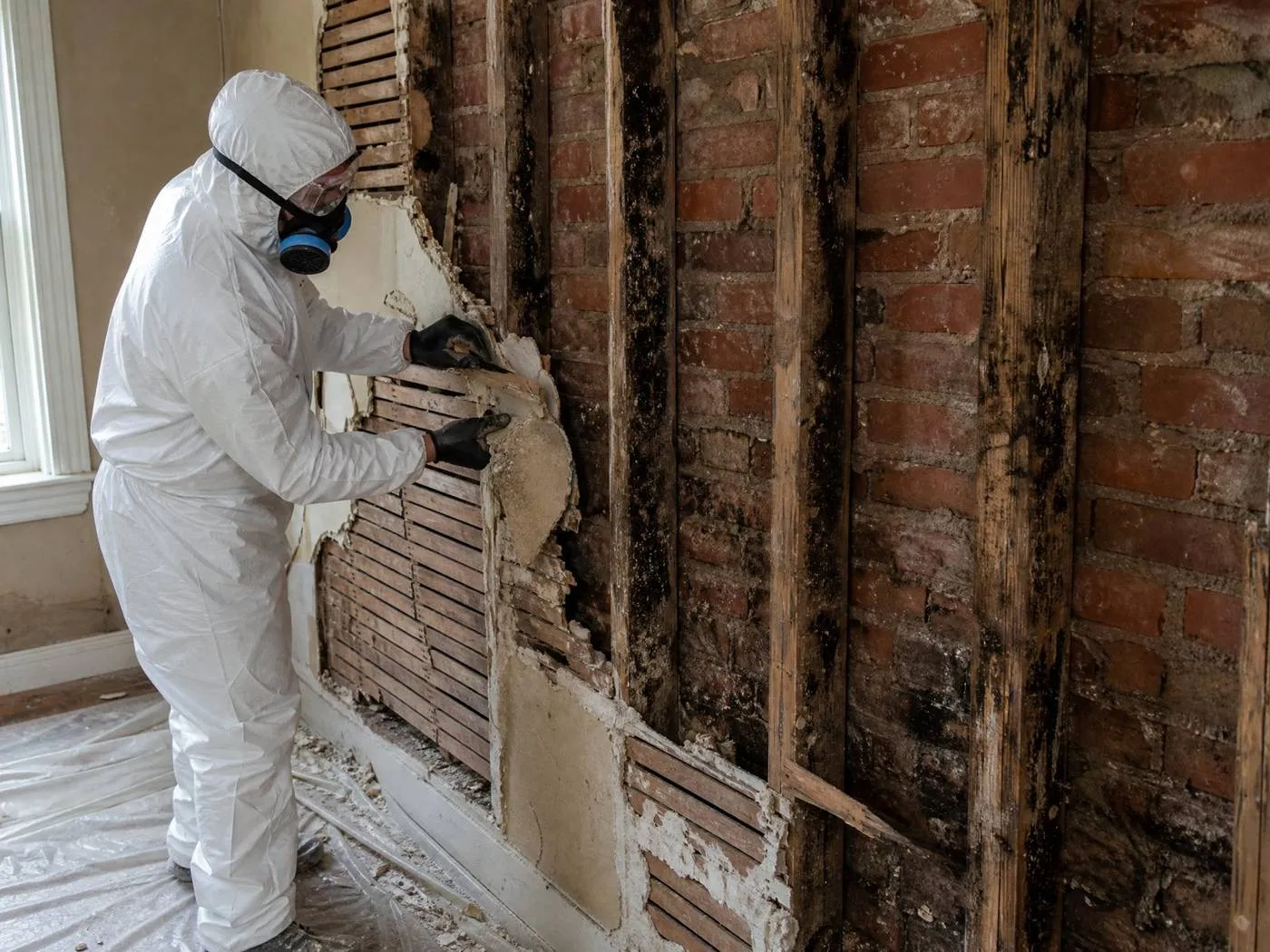
Pennsylvania does not license mold remediation companies. That puts the work on you. Here is what to ask any contractor, us included.
- Certifications, by name. Ask who holds what, and look it up. Ours are IICRC AMRT and WRT, held by our own technicians.
- A real address. Ask for a place you can drive to. Our shop is at 498 Wye Alley in Gettysburg Borough, in town.
- Attorney General registration. Contractors doing about $5,000 or more a year must register. Check at 1-888-520-6680.
- A written contract over $500. Over $5,000, a down payment is capped at one-third, and you generally get three business days to cancel.
- A written scope and price. Before work starts, on paper, with what is included and what is not, so quotes can be compared.
- Proof of insurance. Ask for the certificate, and call the carrier to confirm it is current before anyone sets up.
- A plan for the moisture source. If the quote never says where the water came from or who fixes it, ask before you sign.
- No fogging-only quotes. Fogging over mold without removing it or containing the area is not remediation, however it is worded.
Whether a particular job counts as home improvement can depend on the scope, so ask. Our Pennsylvania mold laws page has the official links, and the FAQ on hiring a mold remediation company covers the red flags.
Buying or Selling a Gettysburg Home With a Mold Finding
Many first calls come from a buyer’s inspection. The report says “possible mold” or “evidence of moisture,” the deal has a deadline, and the seller says it is nothing.
If you are buying: ask for a specific finding, not a general one. Where is the moisture reading, how high is it, and where does it come from? A short independent inspection with a moisture meter and thermal camera usually answers more than a sample does. We can inspect and write up what we find. For a larger issue, a written scope with a price lets you negotiate on a number.
If you are selling: fix the cause, then document the fix. A written scope, an itemized invoice, before and after photos, final moisture readings, and an independent clearance letter if you want one, all make the file easier for a buyer, their inspector, and their lender to accept. Painting over a stain is the worst option. It will show up again at the next inspection.
Our full walk-through is in the guide on mold found during a home inspection. For disclosure obligations, talk to your agent or a Pennsylvania real estate attorney. We are not lawyers and will not guess.
Mold Room by Room in a Gettysburg House
Where the growth is tells us what is feeding it. Here is where we look in the houses around here and what we usually find.
The basement. Fieldstone and brick in the borough, block elsewhere. Look at the bottom of the wall, behind boxes, and around the sump pit. White crust on masonry is usually efflorescence, a moisture clue and not mold. See efflorescence versus mold.
The crawl space. Common under additions, porches, and farmhouses off the Fairfield and Hunterstown Roads. Dirt floors, no vapor barrier, and open vents feed damp joists. Dark growth and sagging insulation are the signs to look for. See crawl space mold removal.
The attic. Dark staining on the north side of the roof sheathing, frosted nails in winter, and bath fan ducts that stop in the insulation. The fix is air sealing and venting first, then cleaning the wood. See attic mold.
Bathroom and kitchen. A fan that is too small, vented into the attic, or never turned on. Grout that stays wet. Under the sink and behind the dishwasher, slow leaks run for months before a stain shows. A ceiling stain below a bath is often a leak.
Exterior walls and closets. North-facing corners, closets on outside walls, and furniture pushed tight to a cold wall. Condensation shows up as dark spots in the corner where air does not move. Pull furniture out and look before assuming a leak.
The ductwork. If the musty smell gets worse when the HVAC runs, we look at the air handler, coil, and duct runs. The EPA says duct cleaning has never been shown to prevent health problems, so we look before we clean. See air duct mold cleaning.
The First 48 Hours After Water Gets In
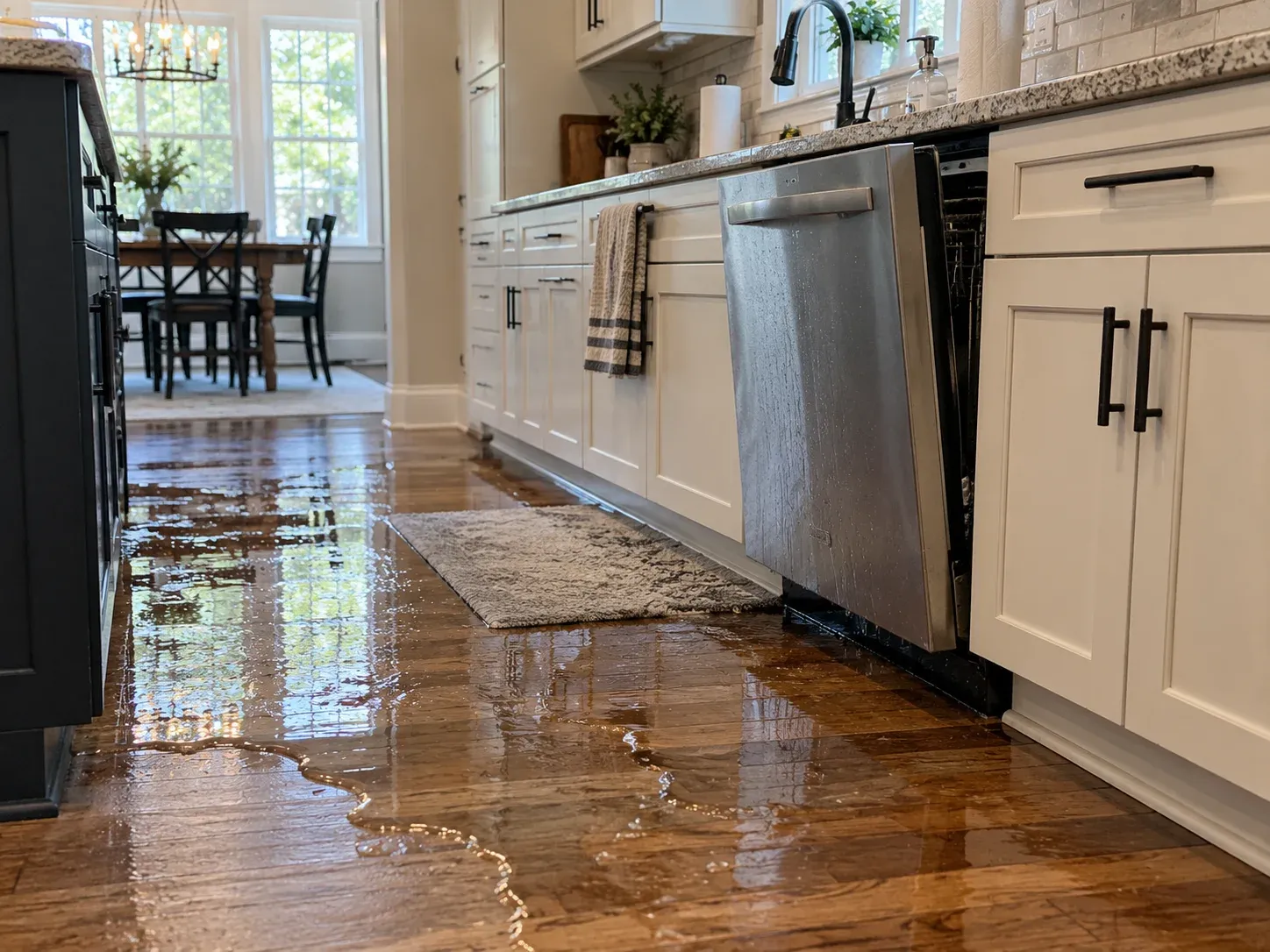
Mold needs moisture, and time. The EPA says that if you dry water-damaged areas within 24 to 48 hours, mold usually will not grow. That window is the most useful fact on this page, so here is what to do with it.
First hour. Stop the water at the source. Shut off the main if a pipe burst, and turn off power to wet areas if you can do it safely. If it was sewer backup or creek water, stay out of it and call us.
First few hours. Take photos and video of everything before you move it, because your insurer will want them. Move furniture, boxes, and rugs off wet floors. Pull up wet carpet if you can do it safely.
Day one. Get air moving and bring in dehumidifiers. If you do not own them, we do. Open windows only if outdoor air is drier than indoor air, which in a Gettysburg summer is often not true. Call your insurer.
Day two. Check drywall, baseboards, and insulation with a moisture meter, not by touch. Wet insulation and wet drywall usually have to come out. If they stayed wet past 48 hours, do not close the walls.
After that. Anything still wet is a mold risk. Do not paint, lay flooring, or close the wall until the framing reads dry. Our water damage and structural drying page has the full process.
When to call us. If drywall, insulation, or carpet padding stayed wet, if the water was sewage, or if you smell mold and cannot find it, call. A quick cut on day one costs far less than a rebuilt wall.
Frozen Pipes and Winter Leaks
Gettysburg has about 121 days a year with a low at or below freezing, and that includes about 25 nights each in December and January. Older borough homes with pipes in exterior walls, unheated crawl spaces, and attached garages are the ones that freeze first. A pipe that splits behind a wall usually does not show itself until the thaw. Then it runs inside the wall for hours.
If you find a wet ceiling or a stain on a wall after a cold snap, shut off the water and call a plumber. Then call us if drywall or insulation is wet. A quick cut and drying on day one is far cheaper than closing the wall over damp framing. If you travel in winter, set the heat no lower than your plumber recommends, and ask a neighbor to check on the house.
How We Decide What Comes Out
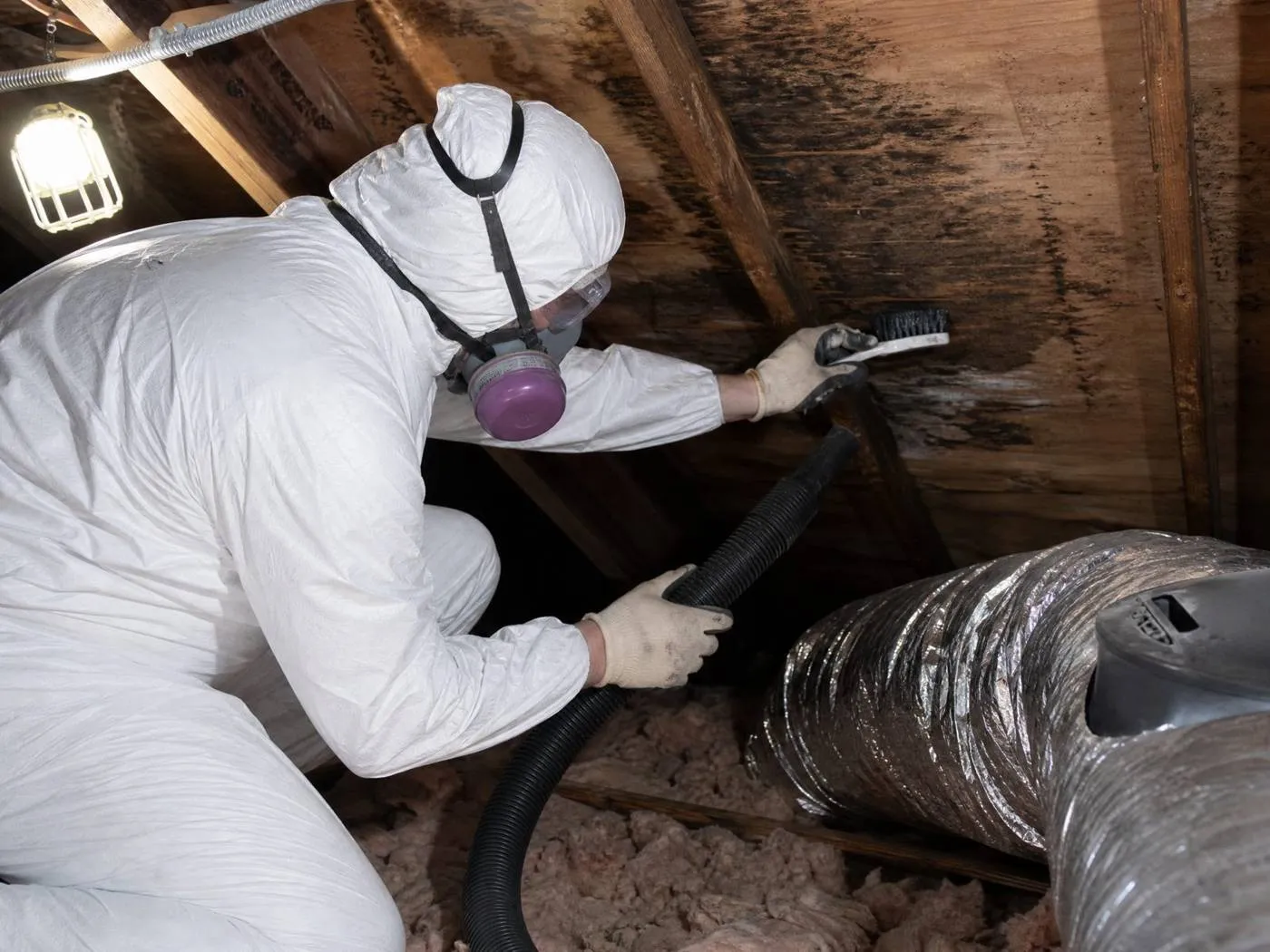
The ANSI/IICRC S520 standard sorts a space into three conditions. Condition 1 is normal fungal ecology, the baseline in every house. Condition 2 is a space where spores from a nearby growth area have settled. Condition 3 is actual growth. The goal of remediation is to return the space to Condition 1, not to sterilize it, and the 2024 edition puts even more weight on physically removing mold, not treating it in place.
In practice, we use three rules. Porous material with growth comes out, because it cannot be reliably cleaned. That is drywall, insulation, ceiling tile, and carpet padding. Semi-porous material like framing gets HEPA-vacuumed, cleaned or abraded, and dried to standard. Non-porous surfaces like tile and glass get cleaned. Then we check with the meter, not with a sniff, before anything goes back in.
Fixing the cause of the moisture is the owner’s job under the standard, though we help. If a gutter, a roof valley, a drain, or a plumbing line is the source, we tell you what we found and who should fix it.
What a Written Scope Looks Like
Every job gets a written scope and a price before we start. Ask any contractor for the same. Here is what should be in it.
- The moisture source. What we found, and whether it has been fixed or still needs a plumber or roofer.
- Areas and materials. What is to be removed, in square feet or linear feet, with photos of each area.
- Containment. The type of barrier, and whether negative air and a HEPA scrubber are running.
- Cleaning method. How framing and surfaces that stay will be cleaned, and what the standard is.
- Drying. The equipment on site and the target moisture readings before anything is closed up.
- Verification. Final readings and photos, and whether clearance testing is included or left to a third party.
- What is not included. Repairs, paint, flooring, and any fix to the water source, listed on their own lines.
- Price and terms. The total, payment terms, timeline, and the warranty, all on the same page.
If a quote is one line with a number on it, you cannot compare it to another. Ask for the scope.
Dehumidifiers, Fans, and What Humidity Control Really Does
Humidity control is the second half of every job. Removing the mold without controlling moisture means it comes back. EPA guidance is indoor relative humidity below 60 percent, ideally 30 to 50 percent.
A portable dehumidifier for a basement typically runs $100 to $300. A whole-house unit ducted into the HVAC system typically runs $5,000 to $6,000 or more installed. These are planning ranges, not quotes. A dehumidifier is a good tool for a basement that is simply humid. It is the wrong tool for a basement with a leak, a wet wall, or a high water table pushing water in. In those cases it keeps filling and the smell stays.
Bath and kitchen fans matter more than most people think. A fan that vents to the outside and runs during and after a shower is a cheap fix. A fan that vents into the attic puts the same moisture onto the roof boards. Check your attic. If the duct ends in insulation, that is the problem.
For basements, our guide on Gettysburg basement humidity in old homes covers what to measure and where.
Rental Properties and Small Commercial Buildings in the Borough
Landlords and small business owners have a different clock. A rental unit that is vacant between tenants, a shop with a back room, or an office on the square has deadlines and tenants and customers. For those jobs we work out a schedule that keeps the rest of the building open.
For multifamily and mixed-use buildings, one source can affect several units. A roof leak, a shared plumbing stack, or a wet party wall crosses the lines on a floor plan. We inspect the whole building and write one scope. For small commercial jobs, see commercial mold removal.
A Gettysburg Mold Calendar
Use the weather table above as a to-do list. This is what we would do through the year in a Gettysburg house.
Every month. Check the lowest part of the house for a damp smell. Run bath fans during and 20 minutes after a shower, and make sure they vent outside. Look under sinks and behind the washer.
March and April. Walk the outside after the thaw. Downspouts should end well away from the foundation. Clear gutters, then test the sump pump with a bucket of water and check where it discharges.
May through September. The wet and humid stretch. Put a hygrometer in the basement and keep humidity under 60 percent, ideally 30 to 50. A dehumidifier with a drain line beats one you have to empty. Keep boxes off the floor.
October and November. Clean gutters again after the leaves come down. Leaf-clogged drains were part of the story on Baltimore Street in October 2019. Check that insulation is not blocking the attic vents.
December through March. Look for frost on the underside of roof boards, and check window sills for condensation. Seal around attic hatches and light fixtures so warm humid air stays out of the attic.
After any leak or flood. Dry within 24 to 48 hours. If drywall, insulation, or padding stayed wet, call us. Our guide on preventing mold has the detail, room by room.
What Not to Do to Mold
A few things we see go wrong before we are called.
- Do not paint or caulk over it. The EPA says not to. Mold under paint keeps growing, and the stain comes back through the new coat.
- Do not fog and walk away. Dead mold still has to come out. A misting treatment leaves the damaged material sitting in the wall.
- Do not mix cleaners. Bleach and ammonia together make a harmful gas, and the EPA does not recommend bleach for routine mold cleanup.
- Do not cut in without containment. Opening a big moldy wall sends spores into the rest of the house, and the cleanup grows.
- Do not just run a dehumidifier. It manages humidity. It does not remove growth, and it does not stop a leak from feeding it.
- Do not trust color. Black does not mean dangerous and white does not mean harmless. See our black mold removal page.
The EPA says that areas of about 10 square feet or less are often something a homeowner can clean. Larger areas, or anything caused by extensive water damage, call for a professional. For health questions, talk to your doctor and see the EPA and CDC pages below.
Neighborhoods, Landmarks, and Places Around Gettysburg
- Downtown Gettysburg and the Historic District around Lincoln Square
- Baltimore Street, Chambersburg Street, and York Street
- Colt Park, Broadway, and Ridge Avenue
- East Lincoln Avenue and Barlow Street
- Cumberland Township, including Herr’s Ridge Road and Cumberland Village
- The Fairfield Road corridor and Greenmount
- Willoughby Run and Old Mill Road
- Straban Township, including Hunterstown and the Hunterstown Road corridor
- Amblebrook and Granite Lake
- The York Road side of town
- The part of Lake Heritage in Straban Township
Public Places We Use to Find Our Way Around
When we drive, these are the landmarks we use. The Gettysburg Borough office is at 59 East High Street. The Gettysburg Fire Department is on North Stratton Street. Cumberland Township’s office is at 1370 Fairfield Road. The Gettysburg Municipal Authority is on East Middle Street. Recreation Park is at 545 Long Lane, 52 acres with ball fields, pavilions, courts, playgrounds, an amphitheater, and a fitness trail. The Gettysburg branch of the Adams County Library System is downtown at Baltimore and High Streets.
Where to Read More
Everything below is a link you can follow. The first group is more from us. The second group is the sources behind the facts on this page, so you can check our work.
Our services. Mold inspection and testing, mold removal, water damage and drying, basement, crawl space, attic, bathroom, black mold, air ducts, indoor air quality, and commercial.
Our guides. Mold or mildew, types of mold, efflorescence versus mold, mold on window sills, mold on drywall, mold on wood, how to prevent mold, are home test kits accurate, how to read test results, humidity in old Gettysburg basements, how you know the job is done, musty basement smell with no visible mold, what not to spray on mold, Stage 4 mold, will mold come back, and mold found during a home inspection.
Questions and costs. Hiring a mold company, inspection and testing, process, insurance, and warranty, water damage and mold, basement, attic, crawl space, and bathroom, the cost page, Pennsylvania mold laws, our mold remediation videos, and about Chuck Dalem and the crew.
Sources for this page.
- EPA, A Brief Guide to Mold, Moisture and Your Home
- EPA, Mold Cleanup in Your Home
- CDC, About Mold and Your Health
- IICRC, ANSI/IICRC S520 Standard for Professional Mold Remediation
- Pennsylvania Attorney General, Home Improvement Contractor brochure
- Adams County Hazard Mitigation Plan 2020
- NOAA NCEI Monthly Climate Normals, Eisenhower NHS
- Gettysburg Borough Storm Water Authority
- Gettysburg Municipal Authority
If you are in Gettysburg and you have a smell, a stain, or a wet basement, call (267) 828-9088 or request an inspection. We will tell you what we see, and if it is not mold, we will tell you that too.
Gettysburg Mold Remediation Pros Services in Gettysburg
Questions we hear a lot
What is the difference between mold removal and mold remediation?
In everyday use, people mean the same job. Remediation is the full process: find and deal with the moisture source, contain the area, physically remove the mold and the porous material it is growing in, clean what stays, dry it to standard, and check the result. Removal is the middle of that list. Spraying, fogging, or painting over mold without taking it out is not either one, and the EPA says not to paint or caulk over it. Our mold removal page walks through each step.
Can black mold be remediated?
Yes. The cleanup is the same for any mold: fix the moisture, remove the growth, clean, and dry. Color does not tell you what kind of mold you have, and the CDC does not treat black mold as uniquely dangerous. If anyone in the house has health concerns, talk to your doctor and see the CDC mold pages. Our black mold removal page explains more.
How long does mold remediation take in a Gettysburg house?
These are typical ranges, not promises. A small bathroom or closet job is usually a day or two. A typical basement or attic is two to five days. A whole-house or post-flood job can run one to three weeks. Drying, lab turnaround if you test, and repairs add time. Most families stay home while we work, and we tell you up front if a particular job calls for something different.
How fast can you get to a Gettysburg address?
We are based in the borough, so most Gettysburg, Cumberland Township, and Straban Township addresses are a short drive. For an active leak, a flooded basement, or water coming through a ceiling, we treat the call as urgent and tell you on the phone when we can be there. Inspections for a smell or a stain are usually scheduled within a few days.
My Gettysburg basement smells musty but I cannot see any mold. Do I need a test?
Not always. A musty smell with nothing visible usually points to a damp spot we need to find, and a moisture meter and thermal camera do that faster than a lab sample. The EPA says that when mold is visible, sampling is usually unnecessary. We tell you up front if a test will not change what you do next.
Do old Gettysburg stone and brick foundations always have mold?
No. Plenty of 1800s cellars are dry and clean. What they have in common is porous masonry that wicks ground moisture and sweats when warm humid air hits cold walls in summer. Mold shows up when something organic is sitting against that damp wall, like cardboard boxes, wood shelving, a finished stud wall, or carpet.
Is Gettysburg's water table really that high?
Adams County's soil mapping for sampled areas off Herr's Ridge Road and Hunterstown Road shows silt loams with a seasonal water table around 21 inches down. That is shallow for a house with a basement. It does not mean every basement is wet. It means that after a long rain, water has less room to drain away before it reaches the foundation.
I rent in the borough. Who is supposed to deal with the mold?
That depends on your lease and on what caused the moisture. Report it to your landlord in writing, with dates and photos, and keep a copy. We can inspect and document the moisture source and write up what we find. Our Pennsylvania mold laws page covers the basics of what the law does and does not say for tenants.
Will my homeowners policy cover mold from a storm?
Most policies treat mold from a sudden, covered event very differently from mold caused by groundwater, seepage, or a slow leak, and flood is usually a separate policy. We document moisture readings, photos, and a written scope so your adjuster has what they need. We cannot tell you what your policy covers. Call your insurer early and ask about mold specifically.
My house is in Amblebrook or another newer Gettysburg-area development. Is mold really a concern in a home built after 2000?
Yes, for different reasons than the old borough homes. Tight, well-insulated houses hold humidity when the AC is off or the house sits empty. A bath fan that dumps into the attic, a supply line behind a fridge, or a sump pump that quits in a storm is all it takes. The cause is usually plumbing, ventilation, or a roof detail, not the foundation.
Does the borough's Historic District affect mold work on my house?
Interior mold removal is not an exterior alteration, so it does not need borough review. The Historic District matters when the moisture fix involves the outside, such as replacing windows, siding, or a roof with different materials. Borough code requires a Certificate of Appropriateness from Borough Council for many of those changes. Check with the borough office before you order materials.
How much does mold removal cost in Gettysburg?
A mold inspection typically runs $300 to $500, small or localized jobs $500 to $1,500, and most remediation projects $1,500 to $6,000. These are typical planning ranges, not quotes. The full table is on this page and the cost page, and your real price comes in writing after we see the house.
What should I do in the first two days after a basement floods in Gettysburg?
Stop the water source if you can, move belongings off wet floors, and start drying right away. The EPA says to dry water-damaged areas within 24 to 48 hours to prevent mold. If the water came from a sewer backup, do not clean it up yourself. Do not mix cleaning products either. Call us if drywall, insulation, or carpet padding stayed wet.
Can I sell my Gettysburg house if there was mold in it?
Yes, people do. A written scope, an itemized invoice, photos, and final moisture readings give a buyer and their inspector something solid to look at. If a buyer's inspector found mold, we can inspect and write up what is behind it. For disclosure rules on your sale, talk to your agent or a Pennsylvania real estate attorney.
Do you also serve Cumberland Township and Straban Township?
Yes. They wrap around the borough and make up most of the Gettysburg mailing area. Cumberland Township has more mid-century and newer housing plus wells and septic systems. Straban Township has the Hunterstown Road farmhouses and the newer Amblebrook area. Different houses fail in different ways, so we start in different places.
- Started in Gettysburg in 2012
- IICRC AMRT and WRT certified
- 1-year warranty on every job
- Chuck is on the job, not just the phone