
The Best Black Mold Remediation in the Gettysburg Area
You found dark, slimy-looking growth on the drywall behind the washer, or black spots spreading across the basement ceiling, and the first thing you searched was black mold. Here's what it actually means, what it doesn't, and how it comes out.
Same Six Steps as Any Mold Job
Find the Water
Stachybotrys needs days to weeks of steady moisture, so finding it means water has been there a while. A slow plumbing leak, a roof leak, or a flood that never fully dried. That gets found first.
Contain the Area
Plastic sheeting, sealed vents, and HEPA air filtration under negative pressure, so what we disturb stays in the work zone.
Remove What's Grown On
Drywall, insulation, ceiling tile, carpet and pad with growth come out and leave in sealed bags. Killing it isn't enough, because dead mold can still cause reactions.
Clean What Stays
Studs, joists, and subfloor get HEPA-vacuumed, wiped, and brushed or blasted where the staining is heavy, then treated.
Dry It to Standard
Framing has to read dry on the meter before anything gets closed up. That's the step rushed jobs skip.
Verify, Then Put It Back
Visual check, no musty odor, dry readings, and independent clearance testing if you want it. Then patch, floor, and paint.
The color doesn't change the job. Find the water, contain it, take it out, dry it, put it back.
What Black Mold Removal Costs
$1,500 to $6,000
Typical planning range for most remediation projects in the Gettysburg area, black mold included. Small or localized jobs run $500 to $1,500. Black mold usually means a long-term leak, so it's often behind drywall, which can push a job higher. These are not quotes.
Size of the Affected Area
And how far it has spread behind what you can see.
What Has to Come Out
Drywall, insulation, and flooring cost more than a hard-surface cleanup.
Access
Behind cabinets, under floors, and in crawl spaces takes longer.
Containment Level
Limited containment for a small area, full negative air for larger ones.
Category of Water
Clean supply water is one thing. Sewage or gray water means more removed and more protection.
How Long It Sat
The longer the leak ran, the deeper it goes into the framing.
The number you can count on comes after the inspection, in writing, before work starts.
Full Mold Removal Cost BreakdownWhat the CDC Says
The CDC doesn't treat any indoor mold as uniquely dangerous, and its guidance is the same for all of it: if you can see it or smell it, remove it, and fix the moisture. You don't need to know the species to do that. Damp, moldy homes can trigger coughing, congestion, and asthma flare-ups, especially for sensitive people. If anyone in the house has symptoms, talk to your doctor.
Do You Need a Test?
Usually not. If you can see it, you're removing it either way, and the EPA says sampling is usually unnecessary when mold is visible. Don't pay for a lab test just to learn its name. Testing earns its cost when you smell mold but can't find it, during a home sale, or when someone in the house has health concerns.
What People Mean by Black Mold
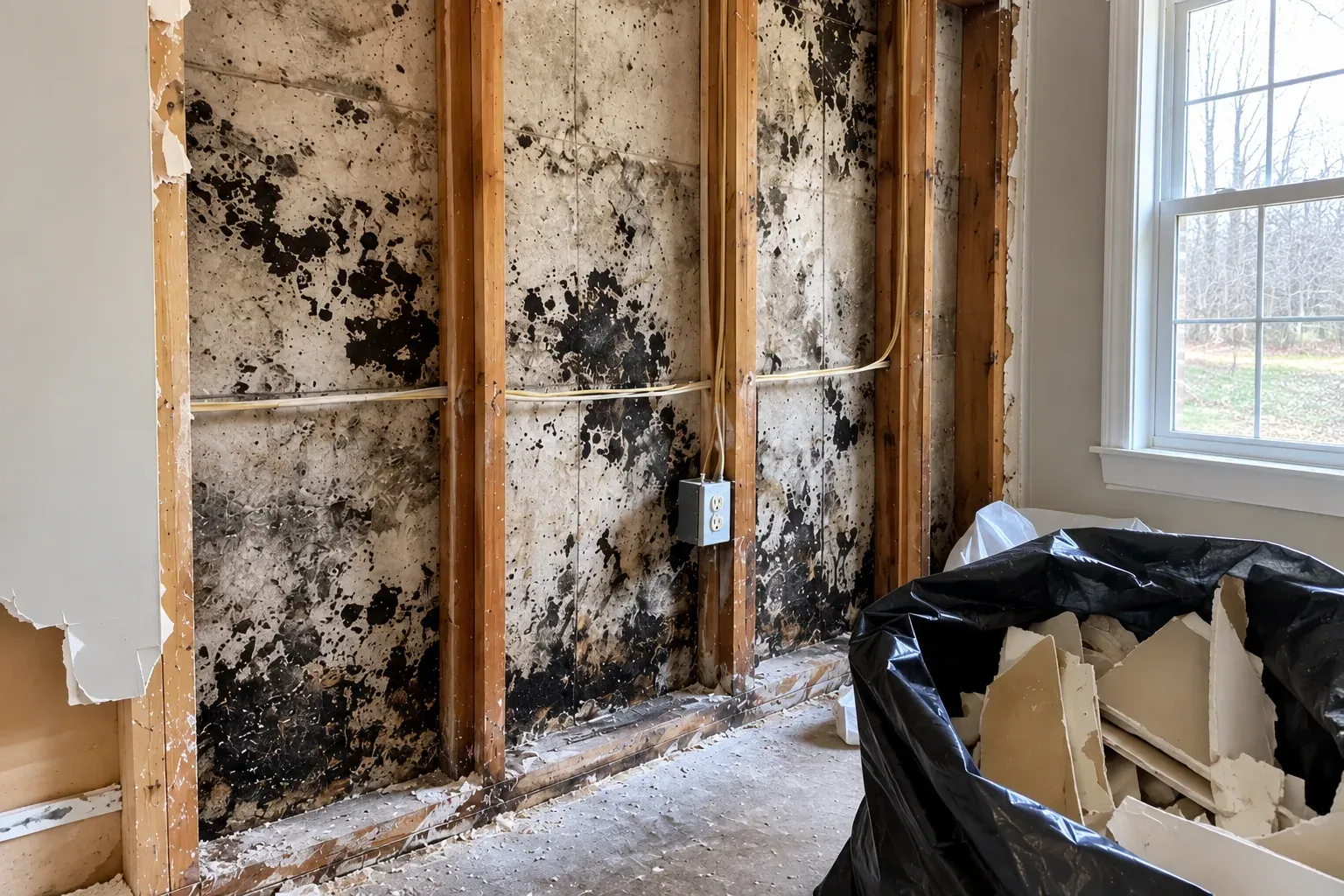
When people say black mold, they usually mean Stachybotrys chartarum. It’s greenish-black, it looks slimy when it’s wet, and it grows on drywall, wood, and paper that has stayed wet for days or weeks. That last part is what matters. Stachybotrys doesn’t show up from a little humidity. It shows up when water has been sitting somewhere for a long time.
But a lot of dark mold in homes isn’t Stachybotrys at all. Cladosporium, one of the most common indoor molds, is olive, brown, or black, and it grows on bathroom ceilings, window sills, basement walls, and attic sheathing. Alternaria is dark and velvety and shows up in showers and under sinks. Color alone tells you very little.
What It Tells Us
Finding dark, slimy growth on drywall tells us more about the water than about the mold. It usually means one of these:
- A slow plumbing leak behind a wall, under a sink, or behind the dishwasher or washer, running for months
- A roof or flashing leak soaking the ceiling or the top of an exterior wall
- A flood or burst pipe that never fully dried, with drywall closed up over wet framing
- A finished basement where drywall sits tight against a damp foundation wall
That’s why we find the water first. Remove the mold without fixing the leak and it’s back.
What Not to Do
- Don’t spray it with bleach. The EPA doesn’t recommend bleach as routine practice, and it doesn’t remove mold from drywall or wood.
- Don’t dry-scrub or sand it without containment. That puts spores into the air of the whole house.
- Don’t paint over it. The paint peels and the growth keeps going underneath.
- Don’t run the HVAC if you think mold may be in the ductwork or the air handler. Call first.
For the CDC’s own guidance, see its page on mold and your health.
Next Steps
If you can see it, a mold inspection maps how far it goes and finds the water. If the leak is still active, start with water damage and structural drying. For how the full job goes, see mold remediation, and for typical prices see mold removal cost in Gettysburg, PA. For everything we do around town, see mold remediation in Gettysburg, PA. For the names behind the labels, see our guide to the molds most often found in houses.
Gettysburg Mold Remediation Pros is a locally owned mold company at 498 Wye Alley, Gettysburg, PA 17325, (267) 828-9088, owned by Chuck Dalem, founded in 2012, and IICRC AMRT and WRT certified.
Related Mold Services
Frequently Asked Questions About Black Mold
Is Black Mold More Dangerous Than Other Mold?
The CDC doesn't treat any indoor mold as uniquely dangerous, and color doesn't identify the species. Most dark mold in homes is a common type like Cladosporium. Stachybotrys, the one in the headlines, needs weeks of steady wetness to grow. All indoor mold gets removed the same way. If anyone in the house has symptoms, talk to your doctor about that and to us about the house.
How do I Know if It's Black Mold?
You can't tell by looking. Plenty of common molds are dark green, brown, or black. Stachybotrys tends to look greenish-black and slimy when wet, and it grows on drywall, wood, and paper after a long-term leak. But the answer doesn't change what happens next, so a lab test just to name it usually isn't worth the money.
Can I Clean Black Mold Myself?
The EPA's rule of thumb is that a patch under about 10 square feet on a hard surface is a homeowner job, whatever the color. Over that, if it's in drywall or insulation, after sewage, or if someone in the house has health concerns, call a professional. Don't dry-scrub it and don't use bleach on drywall or wood.
Do I Have to Leave The House During Black Mold Removal?
Most families stay home. Containment and negative air keep the work zone sealed off from the rest of the house. If anyone has asthma, a weakened immune system, or is very young or elderly, tell us and talk to your doctor about whether a few days elsewhere makes sense.
Find the Water. Remove the Mold. Get Your Home Back.
(267) 828-9088Request an inspection- Started in Gettysburg in 2012
- IICRC AMRT and WRT certified
- 1-year warranty on every job
- Chuck is on the job, not just the phone