Did the Mold Job Pass? What Clearance Means and Who Should Check
The invoice says the mold is gone. Here is what EPA and the states that regulate mold say a finished job has to pass, and how to get the same protections in Pennsylvania.
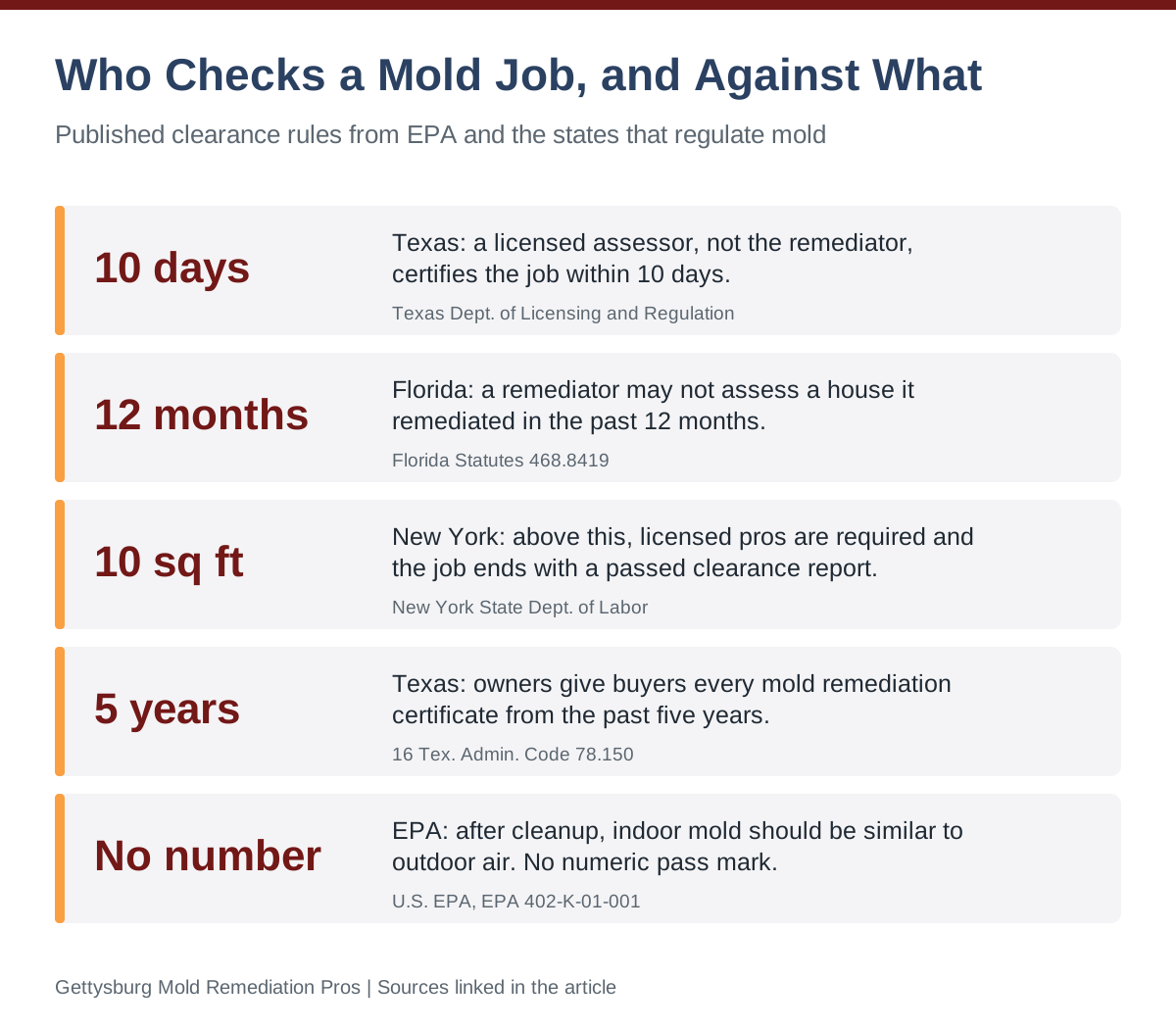
The crew is packing up, the plastic is still hanging, and someone hands you an invoice that says the mold is gone. How do you know? It is the question homeowners ask most often after a mold job, and the honest answer is that it depends on where you live. In Texas, a licensed mold assessment consultant, not the company that did the work, has to certify the job and give the owner a certificate within 10 days (Texas Department of Licensing and Regulation, Mold Assessors and Remediators at a Glance, 2025). In Pennsylvania there is no equivalent rule at all.
That gap matters for anyone hiring for mold remediation in Gettysburg or anywhere else in Adams County. This page puts the published clearance criteria from EPA, New York City’s health department and three states with detailed mold laws side by side, then shows how a Pennsylvania homeowner can write the same protections into a contract before the first wall is opened.
Key Takeaways
- 12 months: Florida bars a mold remediator from assessing a structure its company remediated within the previous 12 months. (Florida Statutes, Section 468.8419, 2024)
- 10 square feet: Above this much mold, New York requires licensed professionals, and the job ends only when the assessor issues a passed clearance report. (New York State Department of Labor, What to Expect When You Hire a Mold Assessor or Mold Remediation Contractor, 2026)
- five years: Texas owners must give buyers a copy of every Certificate of Mold Damage Remediation issued in the five years before the sale. (16 Tex. Admin. Code Section 78.150, 2026)
- similar to those found outside: EPA’s only air-sampling test for a finished job: indoor mold kinds and concentrations should be similar to those found outside. It sets no number. (U.S. EPA, Mold Remediation in Schools and Commercial Buildings (EPA 402-K-01-001), 2008)
- 65%: NYC’s health department guidance says relative humidity should generally stay below 65% to inhibit mold growth. (NYC Department of Health and Mental Hygiene, Guidelines on Assessment and Remediation of Fungi in Indoor Environments, 2008)
- 5,646: Licensed mold assessors and remediators in Texas in fiscal year 2025. (Texas Department of Licensing and Regulation, Mold Assessors and Remediators at a Glance, 2025)
What Do the Published Standards Say a Finished Mold Job Looks Like?
The Straight Answer: They agree on the basics. EPA says you must have completely fixed the water or moisture problem (U.S. EPA, A Brief Guide to Mold, Moisture and Your Home, 2026), that visible mold and moldy odors should be gone, and that a revisit shortly after cleanup should show nothing new. NYC adds that surfaces should be dry and visibly free from mold, dust, and debris (NYC Department of Health and Mental Hygiene, Guidelines on Assessment and Remediation of Fungi in Indoor Environments, 2008). None of them starts with a lab number.
| What | The rule |
|---|---|
| EPA: moisture | completely fixed the water or moisture problem |
| EPA: visible mold and odor | Visible mold and moldy odors should not be present |
| EPA: follow-up visit | revisited the site(s) shortly after cleanup |
| NYC: surfaces | dry and visibly free from mold, dust, and debris |
| New York law: what the assessor must confirm | free of visible mold |
| New York law: written result | passed clearance report |
| IICRC S520 mold remediation standard, current edition | 2024 |
Sources: U.S. EPA, A Brief Guide to Mold, Moisture and Your Home; NYC Department of Health and Mental Hygiene, Guidelines on Assessment and Remediation of Fungi in Indoor Environments; New York Labor Law Section 947 (via Justia); FMLink, IICRC Standard S520 describes procedures for professional mold remediation.
2024: The industry’s mold remediation standard, IICRC S520, was revised that year and includes a post-remediation verification step. (FMLink, IICRC Standard S520 describes procedures for professional mold remediation, 2024)
Read the list as an order of operations. The water comes first: EPA says the cleanup cannot be considered finished until the moisture problem is completely fixed, which is why a job that removes stained drywall but leaves a leaking supply line has not passed anything. Then the visible test: no growth, no mold-damaged materials left in place, no musty smell. Then the follow-up visit, which is the step most often skipped. A basement that looks clean on the day the crew leaves can show new staining a few weeks later if the source was never found, and older stone foundations make that more likely, as our look at basement humidity in older Gettysburg homes explains.
New York is the one state that writes these checks into statute. Its law says a licensed assessor must conduct a post-remediation assessment that confirms the work area is free of visible mold (New York Labor Law Section 947 (via Justia), 2018), that the work followed the remediation plan and met its stated clearance criteria, and then issue a written passed clearance report. The industry’s own standard, IICRC S520, now in its 2024 edition (FMLink, IICRC Standard S520 describes procedures for professional mold remediation, 2024), also includes a post-remediation verification step. It is a paid document, so the public guidance above is what a homeowner can actually hold a contractor to. Our page on what to expect from a mold job, start to finish walks through where that final check sits in a typical Gettysburg project.
Is There a Passing Number for a Mold Clearance Air Test?
The Straight Answer: No published one. EPA says that if samples are taken, indoor mold kinds and concentrations should be similar to those found outside (U.S. EPA, Mold Remediation in Schools and Commercial Buildings (EPA 402-K-01-001), 2008), and calls the final decision a judgment call. NYC’s health department guidance goes further and says there are no standards to compare results against (NYC Department of Health and Mental Hygiene, Guidelines on Assessment and Remediation of Fungi in Indoor Environments, 2008).
| What | The rule |
|---|---|
| EPA: air sample after cleanup | similar to those found outside |
| EPA: final call | a judgment call |
| EPA: what an air sample shows | only for the moment when the sampling occurred |
| EPA: a clean lab result versus a walk-through | must not be used in place of a visual survey |
| NYC: numeric standards for sample results | there are no standards |
| EPA: sampling when mold is visible | sampling is unnecessary |
Sources: U.S. EPA, Mold Remediation in Schools and Commercial Buildings (EPA 402-K-01-001); U.S. EPA, Mold Course Chapter 7: Evaluating the Remediation (archived); NYC Department of Health and Mental Hygiene, Guidelines on Assessment and Remediation of Fungi in Indoor Environments; U.S. EPA, A Brief Guide to Mold, Moisture and Your Home.
This is where most of the confusion comes from. Clearance reports often arrive as a table of spore counts with a green check beside them, and it is natural to assume some agency set the line between pass and fail. None did. EPA’s comparison is relative: the inside of the building should look like the outside air on the same day. Its training material adds two limits that every homeowner should know. An air sample describes the air only for the moment when the sampling occurred (U.S. EPA, Mold Course Chapter 7: Evaluating the Remediation (archived), 2025), and a negative result must not be used in place of a visual survey.
That does not make air sampling useless. A sample taken inside containment, next to an outdoor control taken the same hour, is a reasonable cross-check after the visual inspection passes, especially when the work area was large or hidden behind walls. It just cannot do the job alone. Our guide to reading a mold test report explains what spores per cubic meter and the outdoor comparison mean, and the same logic is why EPA says sampling is unnecessary (U.S. EPA, A Brief Guide to Mold, Moisture and Your Home, 2026) when mold is plainly visible before the work starts. It is also why the store-bought petri dishes covered in our piece on home mold test kits cannot tell you a job passed.
Should the Company That Removed the Mold Run the Clearance Check?
The Straight Answer: The three states with the most detailed mold laws all say no. New York states that No licensee shall perform both mold assessment and mold remediation on the same property (New York Labor Law Section 936, 2026). Florida bars a remediator from assessing a structure it worked on within 12 months (Florida Statutes, Section 468.8419, 2024). Texas requires the completion statement to come from a licensed consultant, not the licensed mold remediator (16 Tex. Admin. Code Section 78.150, 2026).
| What | The rule |
|---|---|
| New York: same company assesses and remediates | No licensee shall perform both mold assessment and mold remediation on the same property |
| Florida: remediator assessing its own job | 12 months |
| Texas: who signs the completion statement | not the licensed mold remediator |
| Texas: licensed assessors and remediators, FY 2025 | 5,646 |
| NYC: lab accreditation | independent and reputable certifying organization |
Sources: New York Labor Law Section 936; Florida Statutes, Section 468.8419; 16 Tex. Admin. Code Section 78.150; Texas Department of Licensing and Regulation, Mold Assessors and Remediators at a Glance; NYC Department of Health and Mental Hygiene, Guidelines on Assessment and Remediation of Fungi in Indoor Environments.
12 months: Florida’s separation rule runs both ways: an assessor also may not remediate a structure it assessed within the same window. (Florida Statutes, Section 468.8419, 2024)
This is the live argument on homeowner forums right now, and the regulated states settled it the same way. The reasoning is simple: the person who grades the work should not be the person paid to do it. Texas runs that system at scale, with 5,646 licensed assessors and remediators in fiscal year 2025 (Texas Department of Licensing and Regulation, Mold Assessors and Remediators at a Glance, 2025), and NYC’s guidance applies the same idea to the lab, recommending one accredited by an independent and reputable certifying organization (NYC Department of Health and Mental Hygiene, Guidelines on Assessment and Remediation of Fungi in Indoor Environments, 2008).
Pennsylvania has no such rule. As we cover in what Pennsylvania law says about mold contractors, the state does not license mold companies at all, so the same firm can inspect, remediate and declare the job finished. Some homeowners are fine with that, especially on a small, visible job. On a large one, or one tied to a home sale, an independent check is the cheapest insurance available. We tell every customer they are welcome to bring in their own inspector for the final check, and the questions to ask before hiring a mold company include asking any contractor whether they will allow it.
Can a Contractor Spray Sealant Over Mold Before the Final Check?
The Straight Answer: Not as a substitute for removal. EPA’s homeowner guide says Do not paint or caulk moldy surfaces (U.S. EPA, A Brief Guide to Mold, Moisture and Your Home, 2026), and its commercial guidance says the goal is to clean up mold, not just to kill the mold (U.S. EPA, Mold Remediation in Schools and Commercial Buildings (EPA 402-K-01-001), 2008). NYC calls anti-microbial paints usually unnecessary after proper remediation (NYC Department of Health and Mental Hygiene, Guidelines on Assessment and Remediation of Fungi in Indoor Environments, 2008).
| What | The rule |
|---|---|
| EPA: painting or caulking | Do not paint or caulk moldy surfaces |
| EPA: bleach and other biocides | not recommended as a routine practice |
| EPA: killing versus removing | not just to kill the mold |
| NYC: anti-microbial paints | usually unnecessary |
| NYC: fogging biocides | is not recommended |
| New York: disinfectants and antimicrobial coatings | specified in the Mold Remediation Plan |
Sources: U.S. EPA, A Brief Guide to Mold, Moisture and Your Home; U.S. EPA, Mold Remediation in Schools and Commercial Buildings (EPA 402-K-01-001); NYC Department of Health and Mental Hygiene, Guidelines on Assessment and Remediation of Fungi in Indoor Environments; New York State Department of Labor, What to Expect When You Hire a Mold Assessor or Mold Remediation Contractor.
The second argument running on homeowner forums is about timing: a crew sprays a white encapsulant on the framing, then calls the inspector. The problem is not the product. It is that a coating applied before the check covers exactly what the inspector needs to see. EPA says biocides such as bleach are not recommended as a routine practice (U.S. EPA, Mold Remediation in Schools and Commercial Buildings (EPA 402-K-01-001), 2008), NYC says fogging with biocides is not recommended (NYC Department of Health and Mental Hygiene, Guidelines on Assessment and Remediation of Fungi in Indoor Environments, 2008), and New York’s rules allow disinfectants and coatings only when they are specified in the Mold Remediation Plan (New York State Department of Labor, What to Expect When You Hire a Mold Assessor or Mold Remediation Contractor, 2026).
The practical rule for a homeowner is sequence. Removal and cleaning first, drying to a documented moisture reading second, the clearance check third, and only then any coating, if the plan calls for one at all. If a contractor wants to coat before the check, ask what the coating is for and ask to see the wood bare first. On drywall the question is usually moot, because damaged board comes out rather than getting painted, as our guide on when drywall has to come out explains.
Pennsylvania Has No Clearance Rule. How Do You Write One Into Your Contract?
The Straight Answer: Borrow the rules from the states that have them. Texas requires a certificate within 10 days (Texas Department of Licensing and Regulation, Mold Assessors and Remediators at a Glance, 2025), before and after photographs (16 Tex. Admin. Code Section 78.150, 2026), and copies to any buyer for five years afterward. New York requires licensed pros above 10 square feet (New York State Department of Labor, What to Expect When You Hire a Mold Assessor or Mold Remediation Contractor, 2026). A Pennsylvania contract can ask for the same.
| What | The rule |
|---|---|
| EPA: small area a homeowner can often handle | 10 square feet |
| EPA and NYC: large area | 100 square feet |
| New York: licensed professionals required above | 10 square feet |
| Texas: projects exempt from licensing | less than 25 square feet |
| Texas: certificate deadline | 10 days |
| Texas: certificates owed to a buyer | five years |
| Texas: before and after photos to the owner | photographs |
| NYC: indoor relative humidity | 65% |
Sources: U.S. EPA, A Brief Guide to Mold, Moisture and Your Home; NYC Department of Health and Mental Hygiene, Guidelines on Assessment and Remediation of Fungi in Indoor Environments; New York State Department of Labor, What to Expect When You Hire a Mold Assessor or Mold Remediation Contractor; Texas Department of Licensing and Regulation, Mold Assessors and Remediators at a Glance; 16 Tex. Admin. Code Section 78.150.
five years: Texas turns a finished mold job into a paper trail that follows the house to the next buyer. (16 Tex. Admin. Code Section 78.150, 2026)
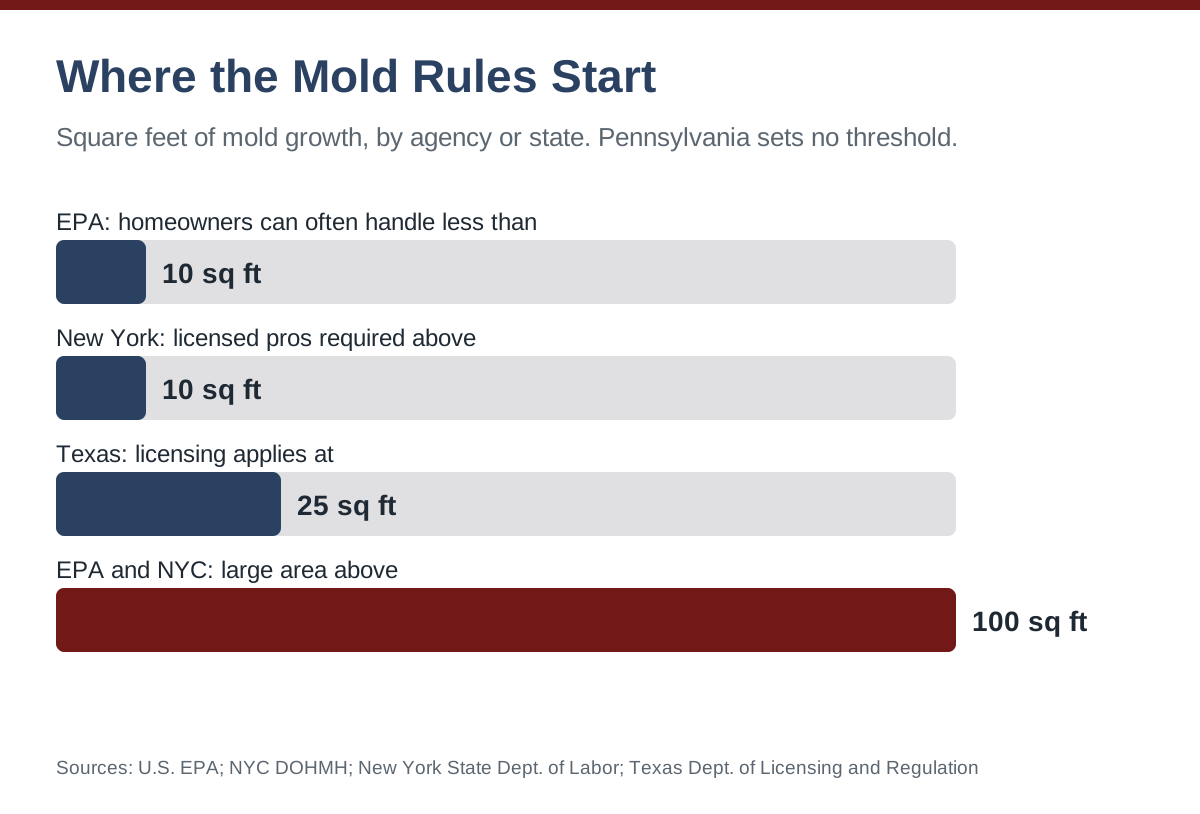
Size tells you how much paperwork a job deserves. EPA says a homeowner can often handle an area under about 10 square feet (U.S. EPA, A Brief Guide to Mold, Moisture and Your Home, 2026), Texas exempts projects of less than 25 square feet from licensing (Texas Department of Licensing and Regulation, Mold Assessors and Remediators at a Glance, 2025), and EPA and NYC treat anything over 100 square feet as a large job (NYC Department of Health and Mental Hygiene, Guidelines on Assessment and Remediation of Fungi in Indoor Environments, 2008). Below the smallest line, a written scope and a moisture reading are plenty. Above it, ask for everything on the list below before you sign, and the mold inspection and testing page explains how an inspection sets up that scope.
A Pennsylvania homeowner can ask for the Texas set in writing: the clearance criteria named in the contract (dry materials, no visible mold, no mold odor, no dust or debris in the work area), the check done before containment comes down, before and after photos, final moisture readings, and the right to bring in an independent inspector. Add a target for keeping the space dry afterward; NYC’s guidance puts indoor relative humidity below 65% (NYC Department of Health and Mental Hygiene, Guidelines on Assessment and Remediation of Fungi in Indoor Environments, 2008). Keep the file. If you sell, a buyer’s inspector will ask for it, and the Gettysburg-area cost guide shows typical planning ranges for inspection and clearance, which are not quotes. For a second set of eyes on a finished job, Gettysburg Mold Remediation Pros is at 498 Wye Alley, Gettysburg, PA 17325, and can be reached at (267) 828-9088.
How We Put This Together
This page compares published criteria and state rules; it does not measure how often mold jobs fail clearance, because no public dataset reports that. Federal guidance comes from EPA’s homeowner guide (updated 2026), EPA 402-K-01-001 (2008 reprint of 2001 guidance) and EPA’s archived mold training course. City guidance comes from the NYC health department’s 2008 guidelines. State rules come from New York Labor Law sections 936 and 947 and the New York Department of Labor, Florida Statutes section 468.8419, and Texas rule 16 TAC 78.150 and the Texas Department of Licensing and Regulation. IICRC S520 is a paid standard and is cited by name and edition only. Pennsylvania has no mold licensing or clearance rule, so the contract checklist is built from those regulated states and from federal guidance, not from Pennsylvania law. Source checks: the NYC guidelines, New York statute pages and Florida statute block automated requests, and several PDF phrases split across lines, so those values were confirmed by reading each page directly on October 31, 2026. No prices appear on this page.
Sources
Checked against these pages on October 31, 2026.
- U.S. EPA, A Brief Guide to Mold, Moisture and Your Home
- U.S. EPA, Mold Remediation in Schools and Commercial Buildings (EPA 402-K-01-001)
- U.S. EPA, Mold Course Chapter 7: Evaluating the Remediation (archived)
- NYC Department of Health and Mental Hygiene, Guidelines on Assessment and Remediation of Fungi in Indoor Environments
- New York State Department of Labor, What to Expect When You Hire a Mold Assessor or Mold Remediation Contractor
- New York Labor Law Section 936
- New York Labor Law Section 947 (via Justia)
- Florida Statutes, Section 468.8419
- 16 Tex. Admin. Code Section 78.150
- Texas Department of Licensing and Regulation, Mold Assessors and Remediators at a Glance
- FMLink, IICRC Standard S520 describes procedures for professional mold remediation
More Questions About Mold Clearance
How do you know mold remediation worked?
EPA's test has no lab number in it. The water or moisture problem has to be completely fixed, visible mold and moldy odors should be gone, and a revisit shortly after cleanup should show no new water damage or growth. NYC's guidance adds that surfaces should be dry and visibly free of mold, dust and debris. If air samples are taken, EPA compares them to outdoor air.
Is there a passing number for a mold clearance air test?
No published one. EPA says that if samples are taken, the kinds and concentrations of mold indoors should be similar to those found outside, and calls the final decision a judgment call. NYC's health department guidance says there are no standards to compare results against. That is why the visual and moisture checks come first and the air sample supports them.
Can the company that removed the mold do the clearance test?
In Pennsylvania, nothing stops it. States that regulate mold say otherwise: New York bars one licensee from doing both assessment and remediation on the same property, Florida bars a remediator from assessing a structure it worked on within 12 months, and Texas requires the completion statement to come from a licensed assessor, not the remediator. Homeowners here can ask for the same separation in writing.
Should a contractor spray a sealant or paint before the clearance check?
Not over mold. EPA says do not paint or caulk moldy surfaces and that the goal is to clean up mold, not just kill it. NYC calls anti-microbial paints usually unnecessary after proper remediation, and New York's rules allow disinfectants and coatings only when the written remediation plan specifies them. A coating applied before the check also hides what the inspector needs to see.
When should the post-remediation check happen?
Before the containment comes down and before any walls are closed. New York's Department of Labor says the contractor may not dismantle containment until the owner has a passed clearance report, which keeps a failed result cheap to fix. EPA also recommends a revisit shortly after cleanup to confirm there are no new signs of water damage or growth.
What paperwork should I get when a mold job is finished?
Pennsylvania requires no mold certificate, so ask for the Texas set by contract. Texas requires a licensed assessor's certificate within 10 days, before and after photographs, and copies to any buyer for five years after. A written scope, moisture readings at the finish, photos and any lab report give a future buyer's inspector the same record.
We Check the Water, the Wood and the Air. In That Order.
(267) 828-9088Request an inspection- Started in Gettysburg in 2012
- IICRC AMRT and WRT certified
- 1-year warranty on every job
- Chuck is on the job, not just the phone