
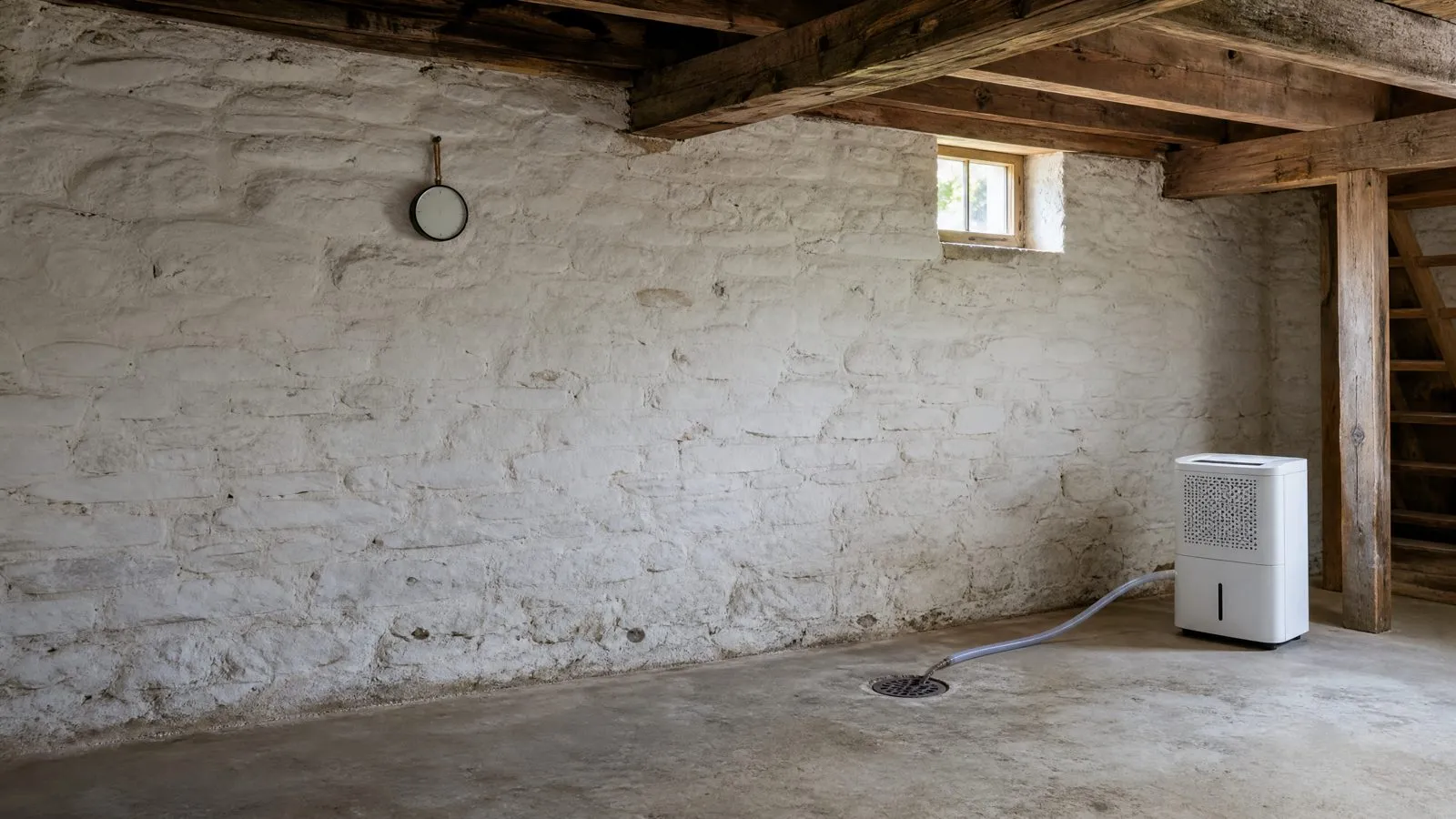
What Basement Humidity Is Normal in an Older Gettysburg Home?
Most humidity advice was written for newer basements. Here is what the published thresholds, local housing data and Gettysburg climate records say about yours.
Nearly half of Gettysburg’s homes are older than most of the advice written about basement humidity. In the borough, 1,331 of 2,801 housing units were built in 1939 or earlier, a share of 47.5%, according to the Census Bureau’s latest five-year survey (U.S. Census Bureau, ACS 2020-2024 5-year, Table B25034 (via Census Reporter), 2024). That is roughly four times the national share of 11.7%. If you just found a musty smell, a white crust on a fieldstone wall or a hygrometer reading that looks high, this page sets the published thresholds next to the local housing and climate data so you can judge your own reading.
The short version: EPA’s indoor target is below 60 percent, ideally between 30 and 50 percent (U.S. EPA, A Brief Guide to Mold, Moisture and Your Home, 2024). That number is real, but it describes room air. Building science judges mold risk at the surface, and the surfaces in an old Adams County basement are cooler and damper than the air in the middle of the room. Where you measure, and for how long, matters as much as the number on the screen.
Key Takeaways
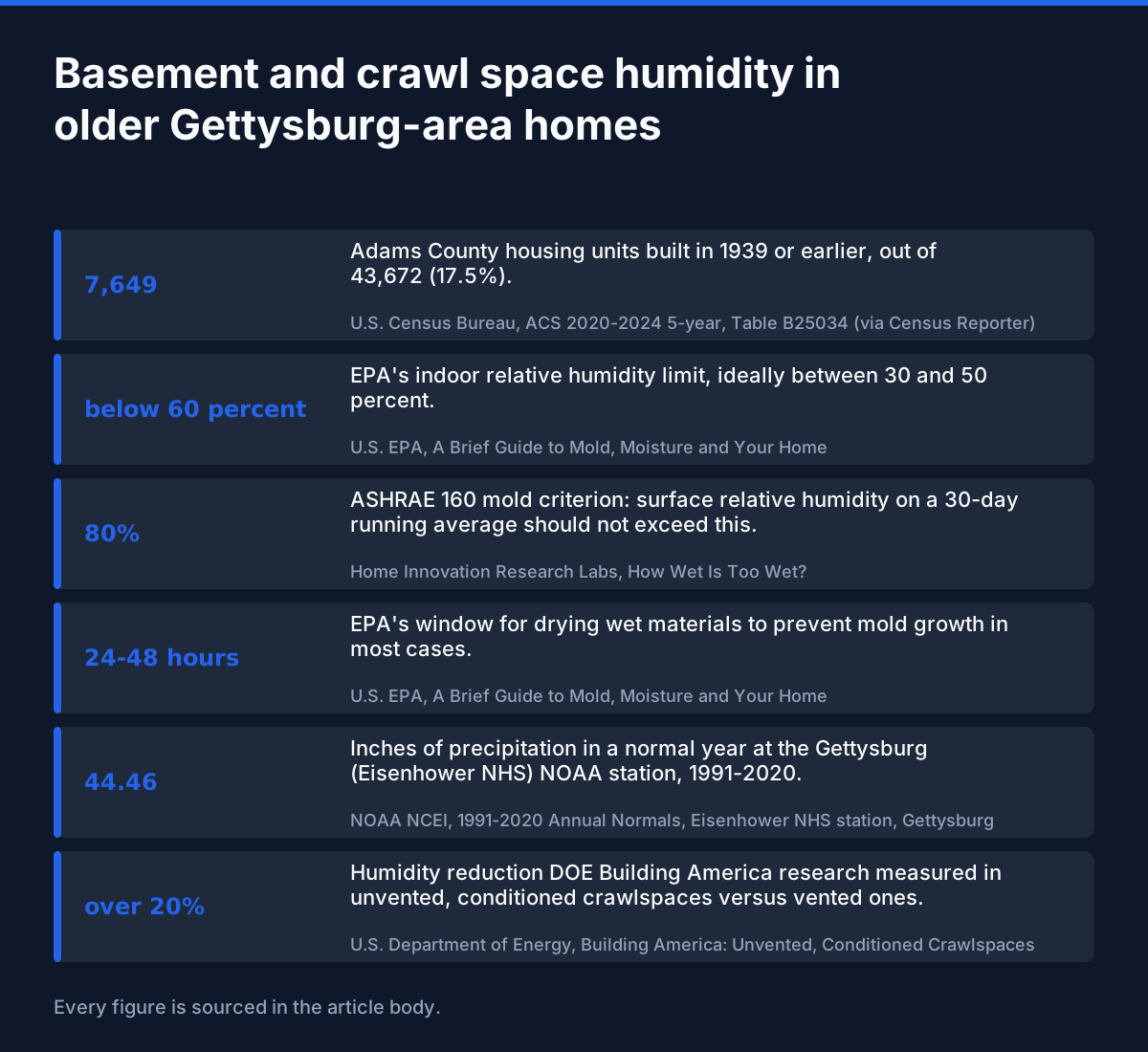
- 7,649: Adams County housing units built in 1939 or earlier, out of 43,672 (17.5%). (U.S. Census Bureau, ACS 2020-2024 5-year, Table B25034 (via Census Reporter), 2024)
- below 60 percent: EPA’s indoor relative humidity limit, ideally between 30 and 50 percent. (U.S. EPA, A Brief Guide to Mold, Moisture and Your Home, 2024)
- 80%: ASHRAE 160 mold criterion: surface relative humidity on a 30-day running average should not exceed this. (Home Innovation Research Labs, How Wet Is Too Wet?, 2013)
- 24-48 hours: EPA’s window for drying wet materials to prevent mold growth in most cases. (U.S. EPA, A Brief Guide to Mold, Moisture and Your Home, 2024)
- 44.46: Inches of precipitation in a normal year at the Gettysburg (Eisenhower NHS) NOAA station, 1991-2020. (NOAA NCEI, 1991-2020 Annual Normals, Eisenhower NHS station, Gettysburg, 2020)
- over 20%: Humidity reduction DOE Building America research measured in unvented, conditioned crawlspaces versus vented ones. (U.S. Department of Energy, Building America: Unvented, Conditioned Crawlspaces, 2014)
How Old Are Gettysburg Homes, and Why Does Age Matter for Moisture?
The Straight Answer: In Gettysburg borough, 1,331 of 2,801 housing units date to 1939 or earlier, or 47.5%, and 69.7% were built before 1960 (U.S. Census Bureau, ACS 2020-2024 5-year, Table B25034 (via Census Reporter), 2024). Adams County as a whole sits at 17.5%, below the Pennsylvania share of 25.0% but well above the national share of 11.7%. Older foundations were built before vapor retarders and engineered foundation drainage became routine.
| Metric | Value |
|---|---|
| Gettysburg borough, units built 1939 or earlier | 1,331 of 2,801 |
| Gettysburg borough, total housing units | 2,801 |
| Gettysburg borough, share built 1939 or earlier | 47.5% |
| Gettysburg borough, share built before 1960 | 69.7% |
| Adams County, units built 1939 or earlier | 7,649 |
| Adams County, total housing units | 43,672 |
| Adams County, share built 1939 or earlier | 17.5% |
| Pennsylvania, share built 1939 or earlier | 25.0% |
| United States, share built 1939 or earlier | 11.7% |
Source: U.S. Census Bureau, ACS 2020-2024 5-year, Table B25034 (via Census Reporter).
69.7%: Share of Gettysburg borough housing built before 1960, the era before modern basement damp-proofing was common. (U.S. Census Bureau, ACS 2020-2024 5-year, Table B25034 (via Census Reporter), 2024)
| Decade built | Housing units in Gettysburg borough |
|---|---|
| 1939 or earlier | 1,331 |
| 1940 to 1949 | 378 |
| 1950 to 1959 | 244 |
| 1960 to 1969 | 252 |
| 1970 to 1979 | 238 |
| 1980 to 1989 | 128 |
| 1990 to 1999 | 81 |
| 2000 to 2009 | 100 |
| 2010 to 2019 | 49 |
Source: U.S. Census Bureau, ACS 2020-2024 5-year, Table B25034 (via Census Reporter), 2024.
The borough figures carry a wide margin of error because the survey samples a small place, but the pattern is not in doubt: the oldest bucket is larger than any later decade by a wide margin in the town itself (U.S. Census Bureau, ACS 2020-2024 5-year, Table B25034 (via Census Reporter), 2024). Countywide the housing stock is newer, yet the county still holds 7,649 pre-1940 units. Houses of that age commonly sit on masonry or stone foundations, sometimes with crawl spaces under later additions, and those details matter for moisture.
That is why generic humidity charts misfire here. A chart written for a poured-wall basement built with a drainage board and a vapor retarder assumes the walls are dry and the room air is the problem. In an older Gettysburg basement the walls themselves move moisture, and a white powdery bloom on the stone is often mineral salt rather than growth. Our guide to telling efflorescence from mold walks through the difference, and the room-by-room mold questions page covers what each part of an older house tends to show.
What Basement Humidity Reading Is Normal?
The Straight Answer: EPA’s guidance for every room, basements included, is to keep relative humidity below 60 percent, ideally between 30 and 50 percent (U.S. EPA, A Brief Guide to Mold, Moisture and Your Home, 2024). Building science adds a surface test: under ASHRAE 160, as summarized by Home Innovation Research Labs, surface humidity on a running monthly average should not exceed 80% (Home Innovation Research Labs, How Wet Is Too Wet?, 2013). Readings between those two lines call for monitoring, not alarm.
| Metric | Value |
|---|---|
| EPA indoor relative humidity limit | below 60 percent |
| EPA ideal indoor range | 30 and 50 percent |
| ASHRAE 160 surface humidity ceiling, running monthly average | 80% |
| Solid wood moisture content at that surface ceiling | 16% |
| Industry dry threshold for solid wood | 19% |
| Relative humidity matching the wood decay rule | 90% |
| Wood moisture rule for preventing decay | 20% |
| Fiber saturation, where decay fungi thrive | 25 to 30% |
Sources: U.S. EPA, A Brief Guide to Mold, Moisture and Your Home; Home Innovation Research Labs, How Wet Is Too Wet?; USDA Forest Service, Carll and Highley, Decay of Wood Above Ground in Buildings.
80%: The ASHRAE 160 mold criterion is a surface number averaged over a month, not a single room-air reading. (Home Innovation Research Labs, How Wet Is Too Wet?, 2013)
These numbers answer different questions, which is why homeowners see so many conflicting targets online. EPA’s range is a whole-house living target. The ASHRAE figure is a design limit for surfaces over weeks. The wood numbers describe the framing: industry treats solid wood as dry below 19% (Home Innovation Research Labs, How Wet Is Too Wet?, 2013), and USDA Forest Service researchers describe the 20% moisture rule as a margin of safety against decay, with decay fungi doing best above fiber saturation at 25 to 30% (USDA Forest Service, Carll and Highley, Decay of Wood Above Ground in Buildings, 1999). A basement can sit somewhat above EPA’s ideal for a few summer weeks without the joists ever reaching those wood levels.
So a single reading of the mid-sixties after a muggy week is a reason to look closer, not a diagnosis. Sustained readings above EPA’s limit, condensation on pipes or walls, or framing that reads wet on a moisture meter are the signals that move a basement from normal-for-its-age into a problem. Our page on mold on joists, studs and subfloor explains what those wood readings mean for whether lumber can be cleaned or has to go.
Your Hygrometer Reads the Room. Mold Reads the Wall.
The Straight Answer: A hygrometer on a shelf measures air in the middle of the room. Mold responds to the surface it sits on, which is why the ASHRAE 160 test is written as surface humidity (Home Innovation Research Labs, How Wet Is Too Wet?, 2013). On a cool stone wall, the same air carries a higher relative humidity than it does a few feet away, so the wall can be at risk while the room reading looks acceptable.
| Metric | Value |
|---|---|
| Surface humidity ceiling, running monthly average | 80% |
| Wood moisture equivalent at that ceiling | 16% |
| Gettysburg annual mean temperature | 52.8 °F |
| Gettysburg July mean overnight low | 62.8 °F |
| Central PA summer example, high temperature | 86 °F |
| Central PA summer example, average humidity | 77% |
Sources: Home Innovation Research Labs, How Wet Is Too Wet?; NOAA NCEI, 1991-2020 Annual Normals, Eisenhower NHS station, Gettysburg; NOAA NCEI, 1991-2020 Monthly Normals, Eisenhower NHS station, Gettysburg; Penn State PA Housing Research Center, Crawlspaces Revisited (webinar handout).
77%: Average humidity on a central Pennsylvania summer day that Penn State’s housing research center used to show crawl space condensation risk. (Penn State PA Housing Research Center, Crawlspaces Revisited (webinar handout), 2020)
Relative humidity depends on temperature. Cool the same air and its relative humidity climbs; cool it enough and water condenses. Penn State’s PA Housing Research Center illustrates this with a central Pennsylvania summer day that reached 86 degrees at 77% average humidity (Penn State PA Housing Research Center, Crawlspaces Revisited (webinar handout), 2020), then shows that air reaching its dew point on cooler crawl space surfaces. Gettysburg’s annual mean temperature is 52.8 degrees and the July overnight low averages 62.8 (NOAA NCEI, 1991-2020 Annual Normals, Eisenhower NHS station, Gettysburg, 2020), so below-grade masonry in midsummer is typically far cooler than the outdoor air drifting in.
The practical fix is cheap: measure in more than one place. Keep one hygrometer in the open room and set a second on a shelf against the coolest exterior wall, and log both for a few weeks across a humid stretch. If the wall reading runs much higher than the room, or you see dampness on the stone or sweating on cold water pipes, EPA advises acting quickly to dry the surface and reduce the source (U.S. EPA, A Brief Guide to Mold, Moisture and Your Home, 2024). Our mold prevention guide covers dehumidifier sizing and placement, and the basement mold removal page lays out what a full repair involves when the wall readings stay high.
Why Do Gettysburg Basements Run Wetter in Summer?
The Straight Answer: Gettysburg averages 44.46 inches of precipitation a year, with June the wettest month at 4.74 inches and September close behind at 4.63 (NOAA NCEI, 1991-2020 Annual Normals, Eisenhower NHS station, Gettysburg, 2020). Summer adds warm, humid air on top of wet soil. In 2026, Harrisburg’s airport recorded 4.95 inches in September against a normal of 4.12 (NOAA NCEI, Global Summary of the Month, Harrisburg International Airport, 2026).
| Metric | Value |
|---|---|
| Gettysburg normal annual precipitation (in.) | 44.46 |
| Wettest month: June normal (in.) | 4.74 |
| September normal (in.) | 4.63 |
| Driest month: February normal (in.) | 2.73 |
| Gettysburg July mean temperature | 74.5 °F |
| Gettysburg January mean temperature | 30.2 °F |
| Harrisburg airport, September 2026 (in.) | 4.95 |
| Harrisburg airport, September normal (in.) | 4.12 |
| Harrisburg airport, July 2026 (in.) | 5.41 |
| Harrisburg airport, July normal (in.) | 4.30 |
Sources: NOAA NCEI, 1991-2020 Annual Normals, Eisenhower NHS station, Gettysburg; NOAA NCEI, 1991-2020 Monthly Normals, Eisenhower NHS station, Gettysburg; NOAA NCEI, Global Summary of the Month, Harrisburg International Airport; NOAA NCEI, 1991-2020 Monthly Normals, Harrisburg International Airport.
4.95: September 2026 precipitation at Harrisburg airport, the nearest NOAA first-order station with 2026 monthly totals, above its long-term normal. (NOAA NCEI, Global Summary of the Month, Harrisburg International Airport, 2026)
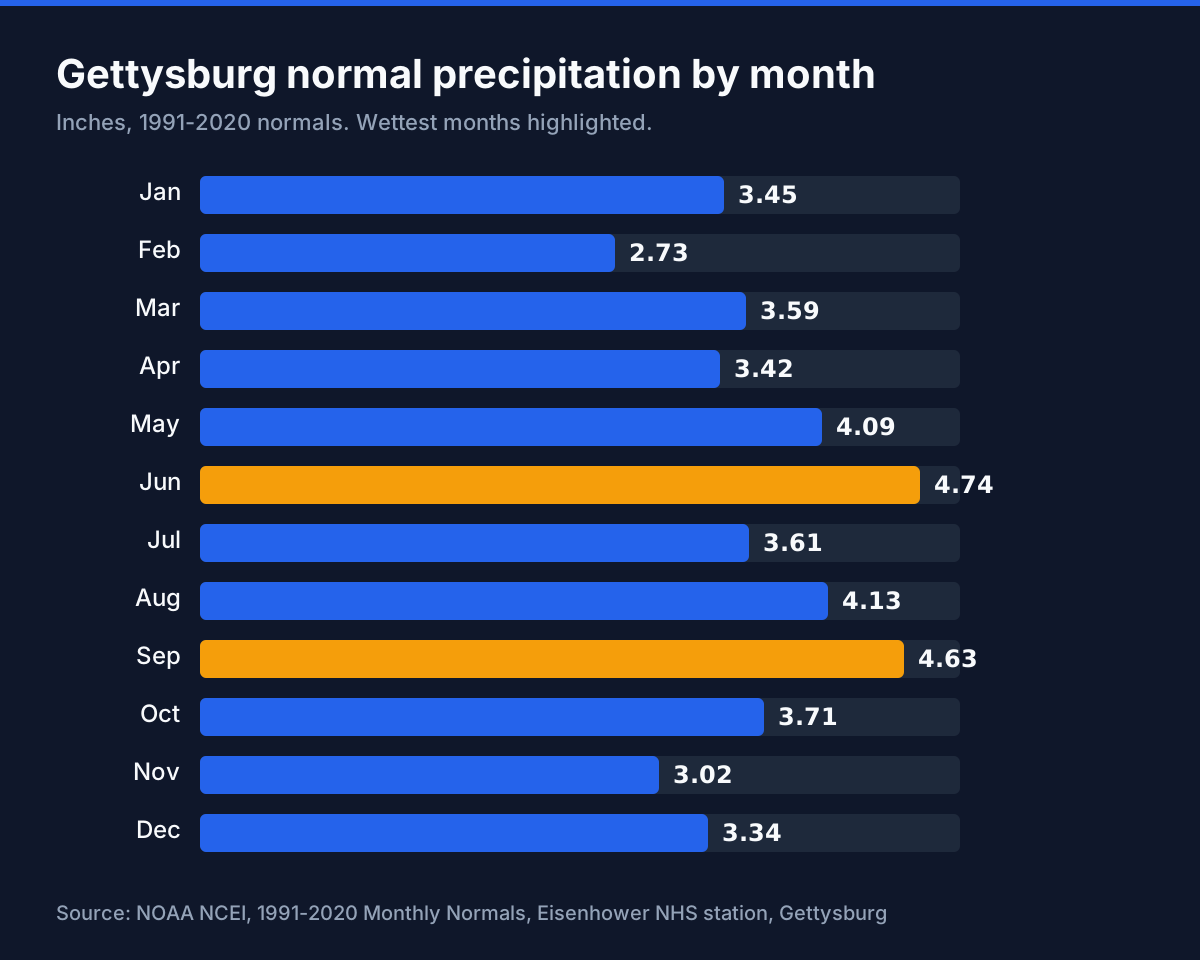
Rain loads the soil against the foundation; summer heat loads the air. The two peak together. NOAA’s normals for the Eisenhower National Historic Site station put Gettysburg’s July mean at 74.5 degrees against 30.2 in January (NOAA NCEI, 1991-2020 Monthly Normals, Eisenhower NHS station, Gettysburg, 2020), and warm air holds far more water vapor than cold air. That is why so many owners of older homes report a basement that is fine in February and musty in August, and why winter is a poor time to judge whether a dehumidifier is keeping up.
This year shows the swing. Harrisburg’s airport, the nearest first-order NOAA station reporting 2026 monthly totals, logged 5.41 inches in July against a normal of 4.30, and 4.95 in September against 4.12 (NOAA NCEI, Global Summary of the Month, Harrisburg International Airport, 2026, for the 2026 totals; NOAA NCEI, 1991-2020 Monthly Normals, Harrisburg International Airport for the normals). Wet late-summer months are when standing water and sump problems show up. If water actually came in, the clock matters more than the humidity reading: see our water damage drying page and the flooded basement and sump pump questions for what to do first.
Do Crawl Space Vents Help in Adams County?
The Straight Answer: The residential code still allows vented crawl spaces, sized at one square foot of vent per 150 square feet of floor, or per 1,500 with a Class I vapor retarder (InterNACHI, Under-Floor (Crawl Space) Code Requirements, 2024). But Department of Energy research found unvented, conditioned crawlspaces cut humidity by over 20% and heating and cooling energy by 15% to 18% (U.S. Department of Energy, Building America: Unvented, Conditioned Crawlspaces, 2014).
| Metric | Value |
|---|---|
| Vented crawl space: floor area per one sq ft of vent | 150 |
| With Class I vapor retarder: floor area per one sq ft of vent | 1,500 |
| Conditioned crawl space supply air: one cfm per this floor area | 50 |
| Humidity reduction, unvented conditioned crawlspaces | over 20% |
| Heating and cooling energy saved | 15% to 18% |
Sources: InterNACHI, Under-Floor (Crawl Space) Code Requirements; U.S. Department of Energy, Building America: Unvented, Conditioned Crawlspaces.
over 20%: Humidity reduction DOE Building America research measured when crawlspaces were sealed and conditioned instead of vented. (U.S. Department of Energy, Building America: Unvented, Conditioned Crawlspaces, 2014)
Vents were meant to dry crawl spaces by moving outdoor air through them. In a humid Pennsylvania summer they often do the opposite, which is why Penn State’s housing research center recommends closing crawl space vents in summer to keep moisture-rich air out (Penn State PA Housing Research Center, Crawlspaces Revisited (webinar handout), 2020). The DOE profile dates to research summarized in 2014, and it notes that the findings helped change the International Residential Code to allow unvented, conditioned crawlspaces, which require a continuous vapor retarder over the soil and conditioned or exhausted air at about one cubic foot per minute for every 50 square feet (InterNACHI, Under-Floor (Crawl Space) Code Requirements, 2024).
For an older Gettysburg house with a crawl space under a rear kitchen or addition, the order of operations matters: stop bulk water first, cover the soil, then decide between a sealed and dehumidified space or a conditioned one. Closing vents without a ground cover traps the soil’s moisture instead of the outdoor air’s. Our crawl space mold removal page compares vapor barriers with full encapsulation, and the Gettysburg-area cost guide gives typical planning ranges for that work, which are not quotes.
When Does a Damp Basement Become a Mold Job?
The Straight Answer: Act when you see wet materials, condensation or visible growth, not on a single number. EPA says wet materials dried within 24-48 hours of a leak usually will not grow mold, and suggests consulting its professional remediation guidance when growth covers more than about 10 square feet (U.S. EPA, A Brief Guide to Mold, Moisture and Your Home, 2024). Below that line, fixing the moisture source comes first.
| Metric | Value |
|---|---|
| EPA drying window to prevent mold | 24-48 hours |
| EPA size threshold for professional guidance | 10 square feet |
| EPA indoor humidity limit | below 60 percent |
| Surface humidity ceiling, running monthly average | 80% |
| Wood moisture rule for preventing decay | 20% |
Sources: U.S. EPA, A Brief Guide to Mold, Moisture and Your Home; Home Innovation Research Labs, How Wet Is Too Wet?; USDA Forest Service, Carll and Highley, Decay of Wood Above Ground in Buildings.
Put the pieces together and a simple test emerges for an older Gettysburg basement. A room reading that drifts above EPA’s limit in summer but drops back, with dry walls and dry wood, is a dehumidifier problem. A wall that stays damp, joists that read wet, a musty smell that does not fade, or growth spreading past a small patch is a moisture source problem, and cleaning without fixing the source tends to bring the growth back. EPA also notes that when mold is visible, sampling is usually unnecessary (U.S. EPA, A Brief Guide to Mold, Moisture and Your Home, 2024), which is why our guide to home mold test kits recommends finding the water before paying for a lab.
For any health question about mold exposure, EPA’s mold guide and CDC’s mold pages are the right starting points, along with your own doctor; this page covers moisture and buildings only. If you would like a second set of eyes on readings from an older home, Gettysburg Mold Remediation Pros is at 498 Wye Alley, Gettysburg, PA 17325, and can be reached at (267) 828-9088. Our mold inspection page explains what an inspection checks and how moisture mapping works.
How We Put This Together
Housing age comes from the Census Bureau’s 2020-2024 American Community Survey five-year Table B25034, read through the Census Reporter API; shares are calculated from those counts, and the borough estimates carry wide margins of error. Climate normals come from NOAA’s 1991-2020 normals for the Eisenhower National Historic Site station in Gettysburg; 2026 monthly rainfall comes from Harrisburg International Airport because the Gettysburg station has not posted 2026 monthly totals. Humidity and wood thresholds come from EPA, the USDA Forest Service, Home Innovation Research Labs (summarizing ASHRAE Standard 160, which is paywalled), the Department of Energy and Penn State’s PA Housing Research Center. Every figure was checked against its source page: NOAA and Census data responses were confirmed by direct download, and Home Innovation figures were confirmed in a browser because that site blocks automated checks. No public dataset measures surface humidity in Adams County basements, so the surface-versus-room comparison is explained from published criteria, not measured locally. Prices are not given on this page.
The housing, soil, and weather numbers behind this are collected in Gettysburg housing, soil, and weather data for mold.
Sources
Checked against these pages in October 2026.
- U.S. Census Bureau, ACS 2020-2024 5-year, Table B25034 (via Census Reporter)
- U.S. EPA, A Brief Guide to Mold, Moisture and Your Home
- Home Innovation Research Labs, How Wet Is Too Wet?
- NOAA NCEI, 1991-2020 Annual Normals, Eisenhower NHS station, Gettysburg
- U.S. Department of Energy, Building America: Unvented, Conditioned Crawlspaces
- NOAA NCEI, 1991-2020 Monthly Normals, Eisenhower NHS station, Gettysburg
- USDA Forest Service, Carll and Highley, Decay of Wood Above Ground in Buildings
- Penn State PA Housing Research Center, Crawlspaces Revisited (webinar handout)
- NOAA NCEI, Global Summary of the Month, Harrisburg International Airport
- NOAA NCEI, 1991-2020 Monthly Normals, Harrisburg International Airport
- InterNACHI, Under-Floor (Crawl Space) Code Requirements
More Questions About Basement Humidity
What humidity should a basement be?
EPA recommends keeping indoor relative humidity below 60 percent, ideally between 30 and 50 percent. That target applies to basements too. In an older Gettysburg basement, read it over several weeks rather than once, because summer readings run higher than winter ones, and a single high afternoon reading after a humid day does not by itself mean mold is growing.
Is 65 percent humidity in my basement a mold problem?
It is above EPA's 60 percent limit, so it is worth fixing, but it is not proof of mold. The building-science criterion in ASHRAE 160, as summarized by Home Innovation Research Labs, looks at surface humidity averaged over 30 days, with 80 percent as the ceiling. Check the coolest wall and any wood near it, not just the room air.
Why do old Gettysburg basements feel damp in summer?
Gettysburg's housing is old: 1,331 of the borough's 2,801 housing units were built in 1939 or earlier, per the Census Bureau's 2020-2024 survey. Those foundations predate modern vapor retarders. In summer, warm humid outdoor air reaches cool masonry walls and its relative humidity rises, which is why many older basements read wetter in July than in January.
Should crawl space vents be open or closed in summer?
Penn State's PA Housing Research Center advises closing crawl space vents in summer to limit moisture-rich outdoor air. Department of Energy Building America research found unvented, conditioned crawlspaces cut humidity by over 20 percent compared with vented ones. Closing vents alone is not a full fix: the ground still needs a vapor retarder and the space needs drying.
How fast do I need to dry a wet basement?
EPA says that if wet or damp materials are dried within 24 to 48 hours of a leak or spill, in most cases mold will not grow. Start with stopping the water, then remove standing water and get air moving. Wet drywall, carpet pad and cardboard boxes are the materials most likely to need removal if they stay wet past that window.
Do I need a mold test if I can already see mold?
EPA states that in most cases, if visible mold growth is present, sampling is unnecessary, and that no federal limits exist for mold or mold spores. EPA also suggests consulting its professional remediation guidance when growth covers more than about 10 square feet. For health questions, EPA and CDC publish guidance; talk with a medical professional about symptoms.
Find the Water First. Then Fix the Basement.
(267) 828-9088Request an inspection- Started in Gettysburg in 2012
- IICRC AMRT and WRT certified
- 1-year warranty on every job
- Chuck is on the job, not just the phone