What Is Stage 4 Mold Contamination?
Someone said your mold is Stage 4, or you read it online and now you are worried. Here is what the term does and does not mean.
Someone told you the mold is Stage 4, or you read it online, and now you are trying to figure out how worried to be.
The Straight Answer: Stage 4 mold is not an official term. The EPA, the CDC, and the IICRC S520 standard do not use it. People use it to mean heavy or widespread growth, and different websites mean different things by it. What matters is where the growth is, how far it has spread, and what is wet. Ask any contractor to put those in writing before you agree to anything.
Where Does “Stage 4” Come From?
From contractor websites, mostly. We have seen it used two ways.
One version describes how mold grows. Spores land, they germinate, they form colonies, and the colonies release more spores. Count those up and the fourth step is the spore-releasing one.
The other version ranks jobs by size, from level 1 to level 5, with the high numbers meaning widespread contamination.
Those are two different systems that happen to share a number. Neither one comes from the EPA, the CDC, or the IICRC. If someone quotes you a stage, ask what the stage means and who defines it.
What Does the Industry Standard Use Instead?
ANSI/IICRC S520 is the standard for professional mold remediation, and it sorts a space into three conditions:
- Condition 1: normal fungal ecology. Every house has some spores floating around and settled on surfaces. The EPA says it is impossible to get rid of all mold and mold spores indoors. This is the baseline.
- Condition 2: settled spores. Spores from a growth area somewhere nearby have drifted and settled in a space that has no growth of its own.
- Condition 3: actual growth. Mold is growing, whether it is active or dormant, visible or hidden.
The goal of remediation is to bring a space back to Condition 1. It is not to sterilize the house. A good scope says which condition each area is in and which one it has to reach at the end.
How Do We Judge How Bad It Is?
We do not give it a number. We look at:
- How much area is affected. The EPA says an area of about 10 square feet or less is often something a homeowner can handle. Larger areas, or anything caused by extensive water damage, call for a professional.
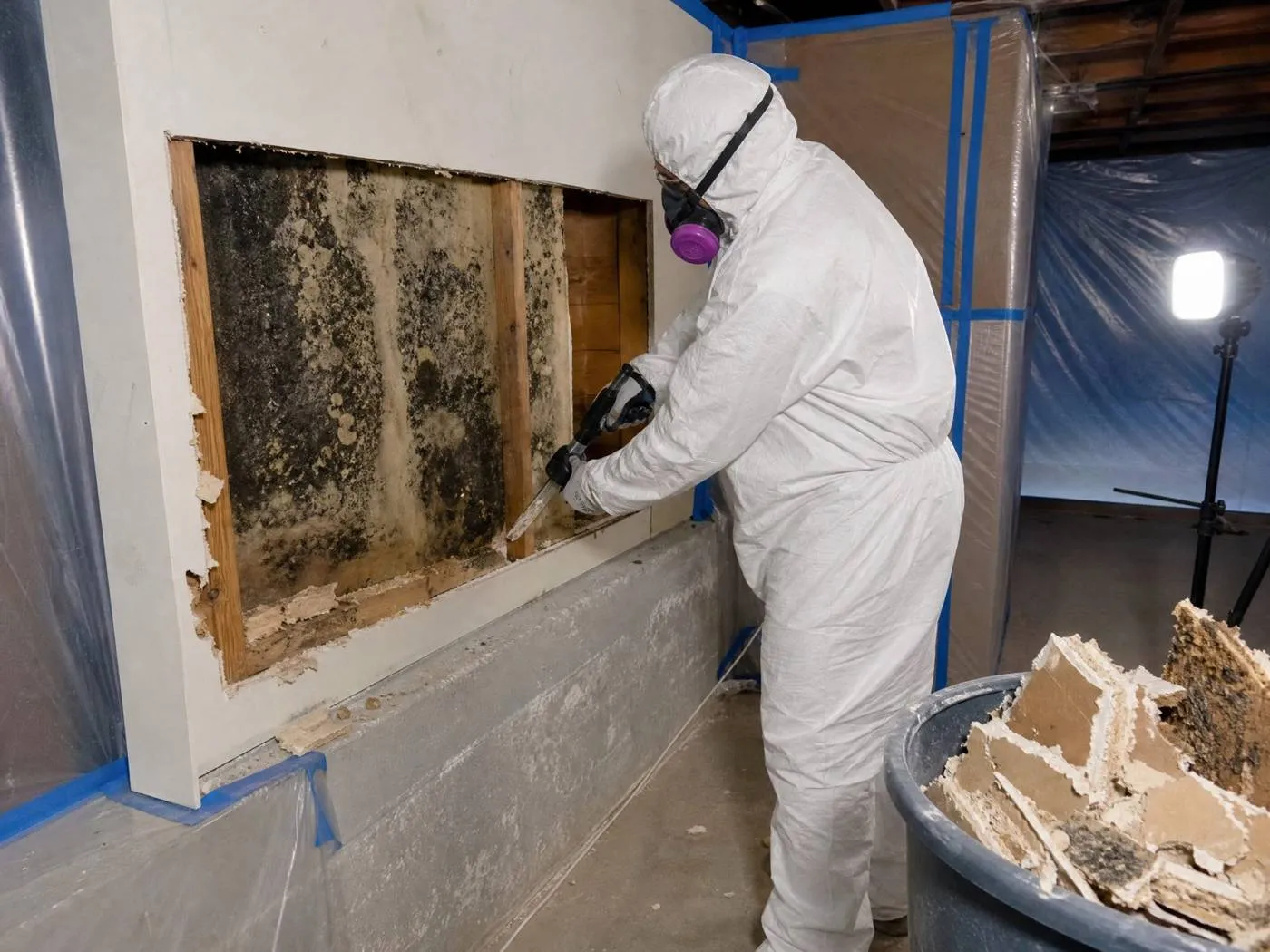
- What it is growing on. Porous materials like drywall, insulation, and carpet padding with growth come out. Framing can usually be cleaned.
- How far the moisture goes. A moisture meter and a thermal camera show wet material behind a wall that looks fine.
- How long it was wet. The EPA says to dry water-damaged areas within 24 to 48 hours to prevent mold growth. The longer it sat, the more likely it went into the materials.
- Whether it reached the HVAC. Mold in the ducts or the air handler is a different job.
- Access. Attics, crawl spaces, and behind cabinets take more work and more containment.
The more of those that apply, the bigger the job. That is why two houses that both have “black mold” can have very different scopes.
Is Heavy Growth Dangerous?
It can be a bigger problem for the house, and for sensitive people. The CDC says people with asthma or mold allergies may have severe reactions, and that people who are immune-compromised or have chronic lung disease may get infections in their lungs from mold. For any health concern, talk to your doctor.
For the rest of us, the answer is the same at any size: fix the moisture, remove the growth, and dry the space. The CDC says you do not need to know the type of mold, and color does not tell you. See our black mold removal page.
What Should the Quote Say?
A real quote has more than a number on it. It should say:
- The moisture source, and who is fixing it.
- The areas and materials coming out, with measurements and photos.
- The containment, and whether negative air is running.
- How framing that stays will be cleaned and dried, with target readings.
- How the job gets verified, and whether clearance testing is included.
If a quote leans on a stage or a scary label and skips all of that, get a second opinion. Our Gettysburg mold remediation page has a section on what a written scope looks like, and our guide on how you know the job is done covers the finish line.
Sources
Checked against these pages in November 2026.
More Questions About Mold Severity
Is Stage 4 the worst kind of mold?
There is no official ranking that puts a Stage 4 above a Stage 3. The term is not defined by the EPA, the CDC, or the IICRC S520 standard. When a website uses it, it usually means heavy or widespread growth, but each site defines it a little differently.
How do I know how bad my mold is?
By measuring, not by naming. How much area is affected, what it is growing on, how long it has been wet, and whether it has spread into walls, floors, or the HVAC all matter. A moisture meter and a thermal camera show how far the damp goes.
Does heavy mold mean I have to leave the house?
Not automatically. It depends on where the growth is and how the work area is contained. Most families stay home while we work. If anyone in your home has asthma, allergies, or a weakened immune system, talk to your doctor and ask us whether staying elsewhere makes sense.
We Measure First. Then We Tell You Straight.
(267) 828-9088Request an inspection- Started in Gettysburg in 2012
- IICRC AMRT and WRT certified
- 1-year warranty on every job
- Chuck is on the job, not just the phone