
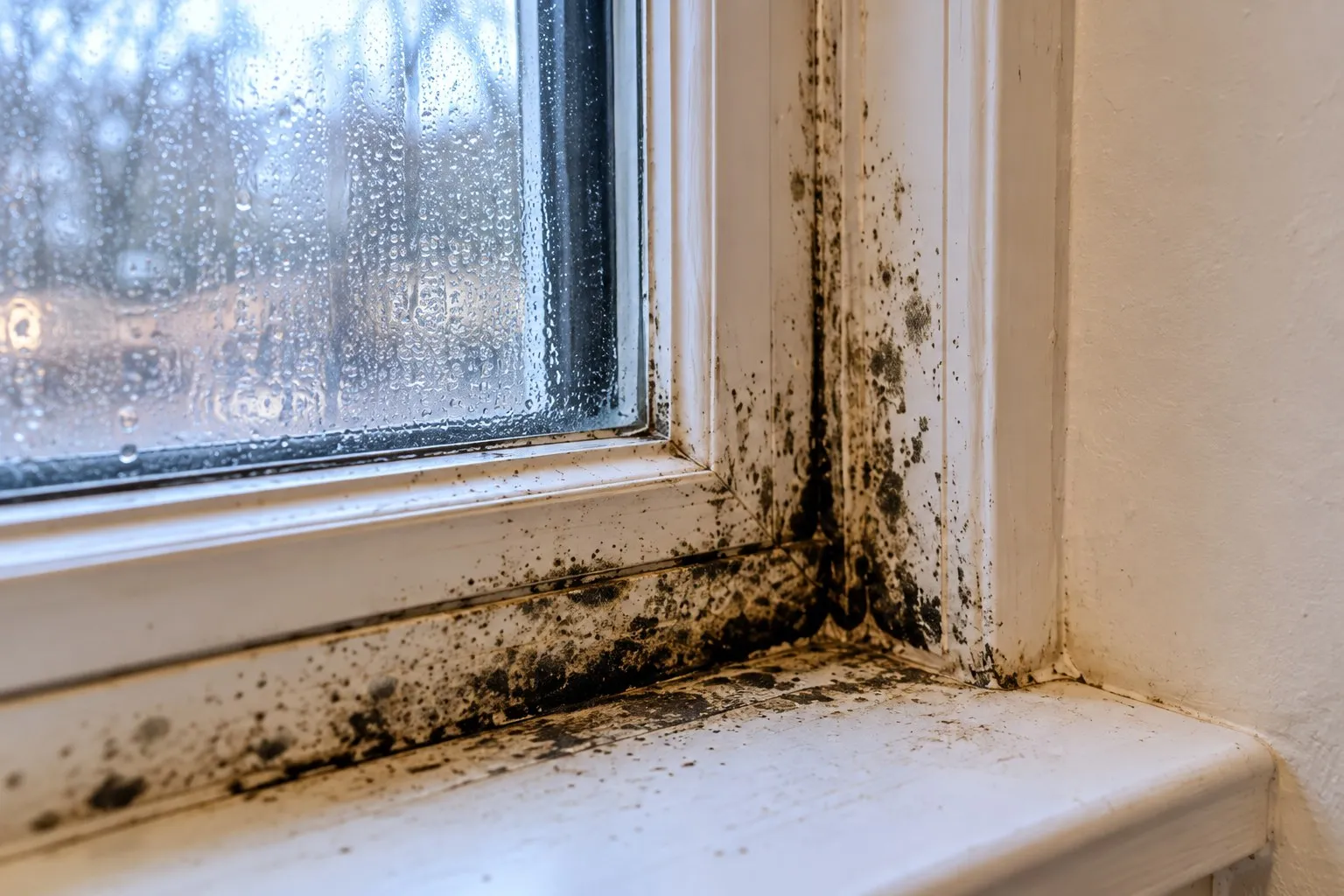
Black Spots on the Window Sill? Here Is What Is Going On
Cold glass, warm indoor air, and a little water sitting still. That is most of the story, and most of the fix.
You wiped the sill last month. It is dark again, and now there are spots on the trim.
The Straight Answer: Mold on a window sill almost always means moisture is sitting there. Most of the time it is condensation, meaning warm, humid indoor air hitting cold glass, but a leak around the window can do the same thing. Wipe it with detergent and water, dry it completely, and figure out where the water is coming from. If the wood is soft, the spots keep returning, or the wall under the window is stained, call us at (267) 828-9088.
Why Does Mold Grow on Window Sills?
Windows are often the coldest surface in a room. The EPA says when warm, humid air touches a cold surface, condensation may form. Water collects on the glass, runs down, and sits in the sash track and on the sill. The EPA’s guidance for school and commercial buildings lists areas around windows where moisture condenses as a common place for mold to grow.
Mold needs moisture, a place to grow, and time. A painted wood or vinyl sill that stays wet most of the winter gives it all three. Long cold stretches with the heat running indoors set that up in many houses.
Is It Condensation or a Leak?
The two can look alike, and both can leave dark corners on a sill. Here is how we sort it out:
- Condensation shows up as water on the inside of the glass when it is cold outside. It tends to be worse in rooms with showers, cooking, drying laundry, or a humidifier. The sill gets wet from the bottom of the glass.
- A leak shows up after rain or wind-driven weather, often as a stain that starts at a top corner or at the edge of the trim. It can keep showing up on days when the glass is dry.
Neither pattern is a guarantee. A moisture meter settles it: if the sill and the wall under it read wet on a dry, mild day, that points toward a leak rather than condensation. We use meters like that on every inspection.
How Do You Clean Mold Off a Window Sill?
For a small area on a hard surface, the EPA says to scrub with detergent and water and dry completely. If the moldy area is less than about 10 square feet, homeowners can usually handle it.
A few rules:
- Wear protection. The CDC says to wear at least an N95 respirator. Gloves and goggles help too.
- Bleach is optional and not routine. The EPA’s brief guide says it is not recommended as a routine practice in mold cleanup. The CDC says bleach or dish detergent can be used, with no more than 1 cup of bleach in 1 gallon of water. Never mix bleach with ammonia or other cleaners.
- Dry it fully. A damp sill grows it back.
- Do not paint or caulk over it. The EPA says paint over a moldy surface is likely to peel.
What About Wood, Vinyl, and Aluminum Windows?
The frame material changes what you are dealing with:
- Wood frames can swell, which leads to rot, warping, and sticking, according to a Penn State course page on window types. Mold on wood can be a surface problem, but soft or spongy wood has gone beyond that. The Massachusetts health department’s homeowner guide says to discard porous materials like wooden trim after flooding or contamination.
- Aluminum conducts heat very rapidly, the Department of Energy says, and Penn State calls it prone to condensation.
- Vinyl does not need painting, the Department of Energy says, but it still gets wet and can still collect mold where water pools.
Old windows in historic houses are a different issue. We would rather look at one than guess from a description, and we would never tell you to rip out original windows over a sill stain.
How Do You Keep It From Coming Back?
Lower the humidity and dry the sill. The EPA says to keep indoor humidity below 60 percent, and ideally between 30 and 50 percent. The CDC says no higher than 50 percent. A cheap hygrometer from the hardware store tells you where you are.
- Run bathroom and kitchen fans that vent outside.
- Run a dehumidifier in winter if the glass runs wet.
- Wipe condensation when you see it.
- Check the caulk and flashing around the window. Damaged caulk falling out around windows is a chronic moisture source, as the Massachusetts guide points out.
If the humidity is fine and the sill still stays wet, you may have a leak or a cold frame. A moisture reading can tell the two apart.
When Is a Window Sill a Bigger Problem?
- The wood is soft, cracked, or peeling.
- The stain extends to the wall below or the ceiling above.
- The mold returns within weeks of cleaning.
- The drywall around the window is damp, bubbled, or stained.
- The affected area is bigger than about 10 square feet.
Any of these means the water has gotten past the sill. We trace it, fix or flag the source, and handle the growth with remediation if it is more than a surface job. If you are not sure what you are looking at, send a photo through our estimate page.
Sources
Checked against these pages in October 2026.
- EPA, A Brief Guide to Mold, Moisture and Your Home, Mold Cleanup in Your Home, and Mold Course, Chapter 2
- EPA, Mold Remediation in Schools and Commercial Buildings
- CDC, Mold and Your Health and Cleaning Up Mold
- Massachusetts Department of Public Health, Mold Cleanup, Repairs and Excessive Moisture Control
- Penn State, EGEE 102, window types
- U.S. Department of Energy, Window Types and Technologies
More Questions About Window Sill Mold
Why do my windows sweat in winter?
Warm, humid indoor air touches cold glass and turns to water. The EPA says condensation may form when warm, humid air contacts a cold surface. The glass is not the cause. The humidity in the house is.
Does mold on a sill mean I need new windows?
Not by itself. If the cause is humidity or a failed seal, fixing that may be enough. Replacement comes into it when the wood frame is soft or rotted, or when the window keeps leaking after the flashing and caulk are fixed.
Do I have to wipe the glass every morning?
If it happens every morning, wiping treats the symptom. The EPA says to act quickly to dry wet surfaces, and a towel does that. The real fix is lowering the humidity in the house so it stops forming.
Is the dark stuff on the sill always mold?
No, and you cannot always tell by looking. The CDC says mold can look like spots of many different colors. Dirt and mold both wipe off, so the test is whether it comes back. If it returns within weeks, the sill is staying wet and it is likely mold.
- Started in Gettysburg in 2012
- IICRC AMRT and WRT certified
- 1-year warranty on every job
- Chuck is on the job, not just the phone