
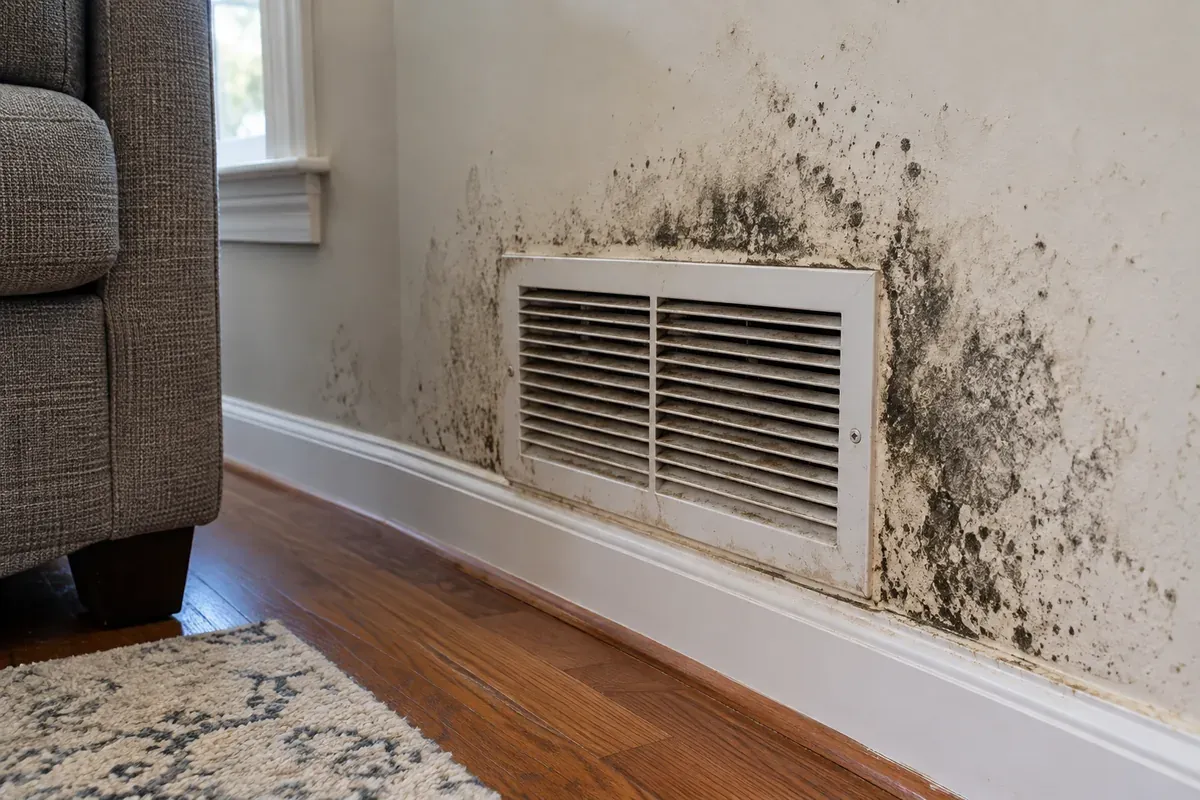
What Mold Remediation Costs Around Gettysburg and Adams County
Most mold remediation jobs around Gettysburg run $1,500 to $6,000. Small, contained jobs run $500 to $1,500, and a mold inspection runs $300 to $500. Here's the full breakdown, what moves the price, and how to get a real number for your house.
Updated October 2026. These are typical planning ranges for homeowners in the Gettysburg area and across Adams County. They are not quotes. Ranges are based on 2026 remediation cost data published by HomeGuide and Angi and approved by Chuck Dalem, our owner. Your price comes after the inspection and depends on what’s affected, access, containment, the moisture source and any repairs.
Inspection and Testing
| Job | Typical Range |
|---|---|
| Mold inspection: visual check, moisture readings, thermal imaging when useful, written findings and scope | $300 to $500 |
| Air sampling: 3 to 5 samples with a lab report | $300 to $700 |
| Clearance testing after remediation, when needed | $250 to $500 |
If you can see the mold, you usually don’t need to pay for an air test. The EPA says the same thing.
Mold Remediation by Size
| Job | Typical Range |
|---|---|
| Small or localized job | $500 to $1,500 |
| Most remediation projects | $1,500 to $6,000 |
| Finished basement after a major water loss, with widespread mold, demo and drying | $10,000 to $30,000+ |
| Whole house | $15,000 to $30,000+ |
| Per square foot of affected area | about $10 to $30 |
The per-square-foot number is for the affected area, not the size of your house. A 2,000 square foot home with one 40 square foot patch is a small job. Black mold is priced the same way as any other mold, because the removal is the same.
Mold Remediation by Room
| Where the Mold Is | Typical Range |
|---|---|
| Bathroom | $500 to $2,000 |
| Basement, partial or localized | $1,500 to $6,000 |
| Basement, extensive or full | $6,000 to $15,000+ |
| Crawl space, typical | $1,500 to $4,000 |
| Crawl space, extensive growth, insulation removal or tight access | $4,000 to $6,000+ |
| Attic, partial or typical | $1,500 to $6,000 |
| Attic, extensive or full | $6,000 to $15,000+ |
Water Damage and Moisture Control
| Job | Typical Range |
|---|---|
| Water damage drying with no extensive mold. Large losses can go higher. | $1,400 to $6,500 |
| Portable basement dehumidifier, depending on pint capacity, coverage, and drainage | $100 to $300 |
| Whole-house dehumidifier ducted into your HVAC system, installed | $5,000 to $6,000+ |
| Crawl space vapor barrier, basic | $1,500 to $4,000 |
| Full crawl space encapsulation | $3,000 to $15,000+ |
More on humidity and air in the house on our indoor air quality page.
Air Ducts and HVAC
| Job | Typical Range |
|---|---|
| Standard duct cleaning | $275 to $500 |
| Mold in ductwork | $600 to $2,000 |
| Mold in HVAC equipment like the air handler and coil | $2,000 to $10,000+ |
Want the real number for your house? Call (267) 828-9088 for an inspection and a written scope with a price before any work starts.
Why Gettysburg-Area Homes Cost What They Do
Adams County and the rest of South Central Pennsylvania have some of the oldest housing in the country, and the house itself changes the job.
- Fieldstone cellars in the borough core. The 1780s to 1890s brick homes between Lincoln Square and Steinwehr Avenue sit on rubble and fieldstone foundations. Stone gets cleaned and treated, not replaced, but uneven walls and low ceilings take more time than a block wall.
- Finished split-levels in Colt Park and Twin Lakes. The 1960s to 80s lower levels often have carpet on the slab and drywall tight against block. The mold is usually behind something, so more comes out and more goes back.
- Tight newer homes at Amblebrook and The Links. Built since 2000 and sealed for efficiency, which also seals in moisture. When the AC sits off through a humid week, humidity control becomes part of the fix.
- Farmhouse crawl spaces off the Fairfield Road. Dirt floors and tight access are the biggest cost drivers we see, and encapsulation is a separate line.
When You Don’t Need Us
The EPA says a patch under about 10 square feet, roughly 3 by 3, on a hard surface is usually something a homeowner can handle. Clean it with detergent and water, fix the moisture, and watch that it doesn’t come back. Call a pro if it’s bigger, in drywall or insulation, came from sewage or dirty water, might be in the HVAC, or anyone in the house has health concerns.
What Our Written Scope Includes
Every quote from us comes in writing before any work starts, so you can compare it line by line:
- Where the water is coming from, and who fixes it
- Where the growth is, and what has to come out
- The containment and air filtration we’ll use
- How we’ll dry it, and the moisture readings that mean done
- Repairs, contents cleaning, and any vapor barrier or encapsulation, each on its own line
- Whether clearance testing is recommended
- The price, and the warranty: 1 year on every job, 2 to 5 years on commercial and insurance-mandated work
Priced in the Written Scope
Some work doesn’t fit a range because it varies too much from one job to the next. These get priced after we’ve seen it and listed separately in your written scope:
- Commercial jobs. Priced after an on-site walkthrough.
- Repairs. Drywall, flooring, and paint after remediation are itemized separately. Major rebuilds we coordinate with trades we trust.
- Contents cleaning. Priced by how much there is and what it is. A couch and a few boxes are a different job from a whole basement of stored belongings.
What Moves the Price
- How big the affected area is, and whether it has spread into wall cavities or other rooms
- What has to come out: drywall, insulation, carpet and pad
- Access. Attics, crawl spaces and the space behind cabinets take more time.
- How much containment and air filtration the job needs
- Whether the water was clean or contaminated
- How long it sat before anyone called
- Fixing the moisture source, so the mold doesn’t come back
Why Calling Early Costs Less
Calling early is the cheapest option. Caught early, it’s often a small cut-out with basic containment and some drying. Left for a season, the same leak can mean multi-room containment, negative air, tear-out, and rebuild. Left long enough, it can mean rotted framing and structural repair.
Wet materials can start growing mold within 24 to 48 hours. A leak you find in a week is a small job. A leak behind a dishwasher for three years is not.
How to Get a Real Number
Call us at (267) 828-9088 and we’ll set up an inspection. We find the moisture source, map how far the growth goes, and give you a written scope with a price before any work starts. No surprise line items. If it’s a small job you can handle yourself, we’ll tell you that too.
For how the work itself goes, see mold remediation. For everything we do around town, see mold remediation in Gettysburg, PA.
Gettysburg Mold Remediation Pros is a locally owned mold company at 498 Wye Alley, Gettysburg, PA 17325, (267) 828-9088, owned by Chuck Dalem, founded in 2012, and IICRC AMRT and WRT certified.
Mold Removal Cost Questions
How much does mold removal cost around Gettysburg?
Most typical remediation projects run $1,500 to $6,000. Small or localized jobs run $500 to $1,500. A finished basement after a major water loss, with widespread mold, can be $10,000 to $30,000 or more. These are planning ranges, not quotes. The real number comes after an inspection, in writing.
How much does a mold inspection cost?
An inspection with a visual check, moisture readings, thermal imaging when it's useful, and written findings and scope typically runs $300 to $500 in this area. Air sampling is separate, typically $300 to $700 for three to five samples with a lab report, and you often don't need it.
Is crawl space encapsulation included in the remediation price?
No. Cleaning the mold off the joists is the remediation. Keeping the crawl space dry afterward is a separate job and a separate line in the written scope. A basic vapor barrier typically runs $1,500 to $4,000, and full encapsulation $3,000 to $15,000 or more. Not every crawl space needs encapsulation, and we'll tell you if yours doesn't.
Why can a per-square-foot price be misleading?
Because it only counts the affected area, not the work around it. Ten square feet of mold behind a vanity can take more time than forty square feet on an open basement wall, once you add access, containment, drying, and fixing the leak. Use the per-square-foot number as a rough check, not a quote.
Why are some quotes so much higher than others?
Usually scope. One quote may include containment, removal, drying, and repairs while another only covers spraying the surface. Others jump straight to expensive duct work or whole-house treatment before anyone has found the moisture source. Compare what's included, in writing, and ask each company where the water is coming from.
How can I keep the cost of mold removal down?
Call early, because a small leak caught in days is a small job. Stop the water if you can do it safely, shut off the HVAC if you think it's in the ducts, and don't dry-scrub or disturb the growth. Skip lab tests you don't need when the mold is visible. And if the patch is under about 10 square feet on a hard surface, you can often handle it yourself.
Find the Water. Remove the Mold. Get Your Home Back.
(267) 828-9088Request an inspection- Started in Gettysburg in 2012
- IICRC AMRT and WRT certified
- 1-year warranty on every job
- Chuck is on the job, not just the phone