
Mold on Drywall: When It Can Be Cleaned and When It Has to Come Out
Drywall soaks up water and hides what is behind it. Here is how to decide what to do with a stained or soft spot.
You pressed on a stained spot on the wall and it felt soft, or you can smell something behind the paint.
The Straight Answer: If mold is on the surface of firm, dry drywall and the patch is small, you can clean it. If the board is wet, soft, swollen, or moldy through the paper, it has to come out, because mold gets into porous material and cleaning the face does not reach it. Either way, the leak or the humidity has to be fixed first. For anything bigger than about 10 square feet, call us at (267) 828-9088.
Can You Just Wipe Mold Off Drywall?
Sometimes, for a light surface spot on a wall that is firm and dry. The EPA says absorbent or porous materials, such as ceiling tiles and carpet, may have to be thrown away if they become moldy. Drywall behaves the same way. It is paper and gypsum, it soaks up water, and growth can sit inside it and on the back.
That last part matters. The EPA’s brief guide says mold may be hidden on the back side of drywall, wallpaper, or paneling. What you see on the front can be the smaller half of the problem.
Do not paint over it either. The EPA says do not paint or caulk moldy surfaces, because paint over mold peels. New York City’s health department adds that antimicrobial paints should not stand in for mold removal and proper moisture control.
How Do You Know What Is Behind the Wall?
Start with your senses. Stained or bubbled paint, a musty smell, a soft or crumbly spot, and warped baseboards all point to water. Homeowners often describe a wall as soft and musty.
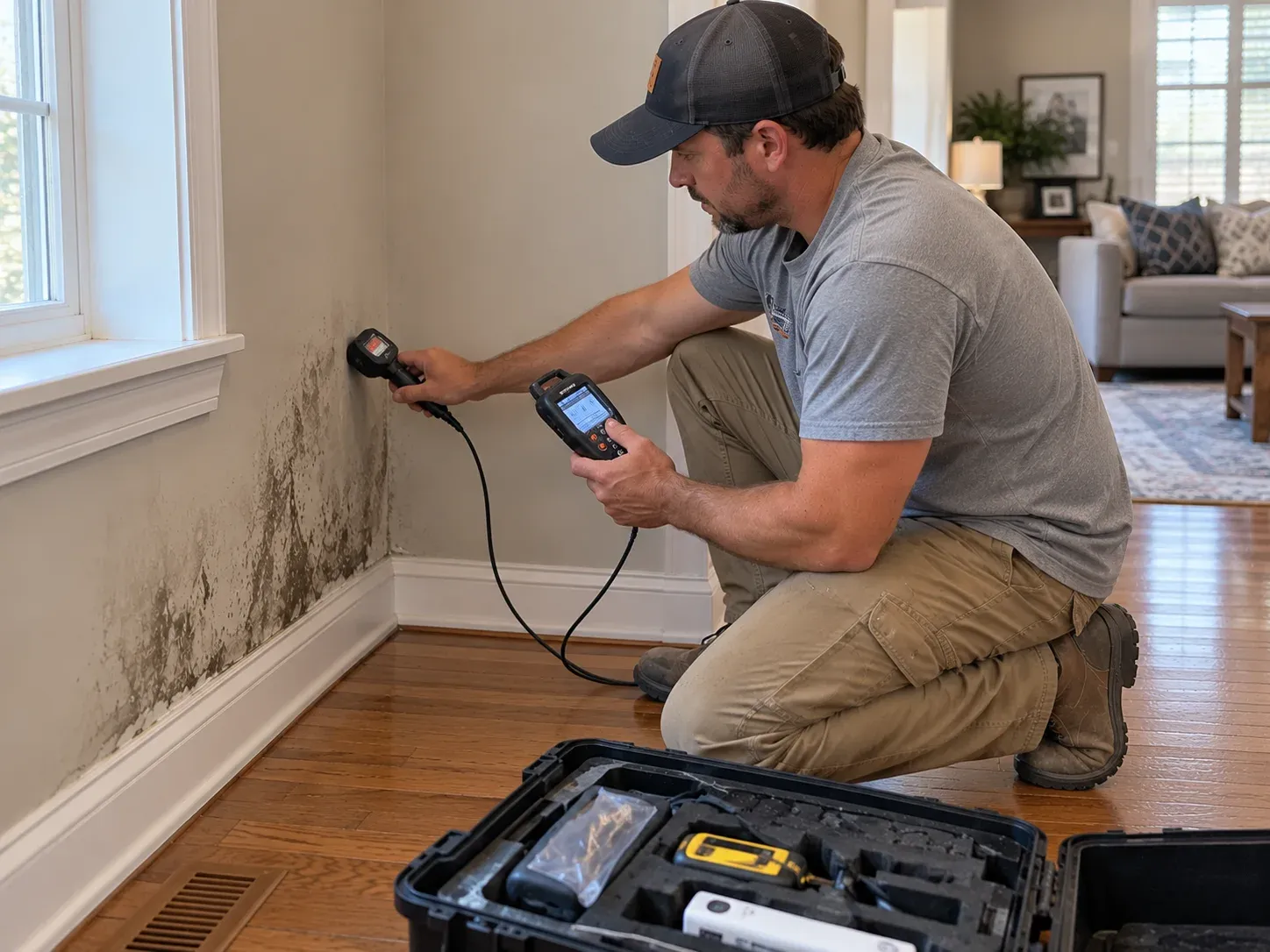
Then measure. A moisture meter can tell you whether the wall is still wet without opening it, and a thermal camera can help spot cool, damp areas. The EPA says moisture meters can help measure the moisture content in building materials. A meter tells you the wall is wet. It does not tell you mold is present, and a dry reading does not tell you there was never water. We use meters to find the edges of the wet area and to prove the wall is dry afterward.
A wall can also be wet without mold yet. The EPA’s water-damage table says wallboard may be dried in place if it is addressed within 24 to 48 hours, there is no obvious swelling, and the seams are intact. After 48 hours, wet materials fall under the EPA’s mold-remediation guidance.
When Does Drywall Have to Come Out?
Cut it out when:
- It is swollen, soft, crumbly, or stained all the way through.
- Mold is on both sides, or on the back when you open a small hole.
- It was wet for more than a day or two and did not dry.
- The water was sewage or flood water.
- The patch is bigger than about 10 square feet.
The EPA says the key is moisture control and that wet porous materials with mold on them may have to be discarded. Finished basements are where this gets expensive. Drywall, carpet, and baseboard often get wet together, and the drywall is often the first thing that has to go.
How Much Do You Cut Out?
Past the visible edge, and farther if the wall is still reading wet. There is no single number every source agrees on. New York City’s guideline says at least six inches beyond visible growth. The University of Toronto’s procedure says about 30 centimeters, close to a foot. The EPA does not give a distance.
We decide with a meter in hand. We keep cutting until moisture readings come back dry, and we put the readings in writing.
Can You Do It Yourself?
For a small patch, yes, if the cause is fixed. The EPA says homeowners can usually handle an area smaller than about 10 square feet. Wear an N95, gloves, and goggles. Bag the material before you carry it through the house.
Know what you are skipping. A pro job uses containment, which is plastic sheeting sealed around the work, plus air filtration with a HEPA unit so spores do not travel through the house. The EPA says HEPA vacuums are recommended for final cleanup after materials are thoroughly dried, and it advises against using wet vacuums on porous materials like gypsum board. A shop vac without a HEPA filter can blow fine dust back into the room.
If there is any doubt about size, hidden growth, or what the water was, stop cutting and call.
What Happens After the Drywall Comes Out?
The studs behind it have to be dry and cleaned before anything goes back. That is the part rushed jobs skip. We get called in to redo work where walls were closed up before the framing was dry. Mold on framing is its own topic, and it is where a lot of regrowth starts.
We handle light repairs, including drywall patching and painting, and we list them separately in the written scope. Bigger rebuilds go to trusted trades we coordinate with. For cost drivers, see what mold removal costs around Gettysburg.
Sources
Checked against these pages in October 2026.
- EPA, Mold Cleanup in Your Home and A Brief Guide to Mold, Moisture and Your Home
- EPA, Mold Remediation in Schools and Commercial Buildings, Chapters 3 and 4 and the full guide
- New York City Department of Health, Guidelines on Assessment and Remediation of Fungi in Indoor Environments
- University of Toronto Environmental Health and Safety, Mould Control Program procedures
More Questions About Mold on Drywall
Why does mold like drywall so much?
Mold needs moisture and something to eat. Anything with cellulose works, and the paper facing on drywall is cellulose. Drywall also holds water once it gets wet, so it stays damp long after the leak stops.
Can mold be growing behind drywall when the front looks fine?
Yes. The EPA says mold can hide on the back side of drywall, wallpaper, and paneling. That is why we take moisture readings before anyone cuts anything. Staining, bubbled paint, a musty smell, or a soft spot are the usual clues.
Will mold-blocking primer fix it?
No. The EPA says do not paint or caulk moldy surfaces, and New York City's health department says antimicrobial paints should not be used in place of mold removal and moisture control. A mold-blocking primer is paint. It covers the stain and the cause is still there.
Will mold come back after new drywall goes up?
Not if the water is fixed and the framing behind it is dry and cleaned first. If either is skipped, yes. Nobody can promise mold will never return. What we can do is fix the cause and document that the wall is dry before it is closed.
We Will Check What Is Behind It Before Anything Gets Cut.
(267) 828-9088Request an inspection- Started in Gettysburg in 2012
- IICRC AMRT and WRT certified
- 1-year warranty on every job
- Chuck is on the job, not just the phone