You Have a Mold Test Report. Here Is What It Means.
A page of Latin names and big numbers does not explain itself. Here is how to read it without panicking.
The lab sent you a report with a column of Latin names, a column of numbers, and no clear verdict.
The Straight Answer: An air test report is a snapshot, and it is meant to be compared to another snapshot taken outside. There is no federal number that separates safe from unsafe, so a count alone cannot give you a pass or fail. What matters is whether indoor results are meaningfully higher than outdoor ones, whether the kinds of mold match, and whether an inspector found moisture or growth to go with it. If you want a second set of eyes on a report, call us at (267) 828-9088.
What Does “Spores per Cubic Meter” Mean?
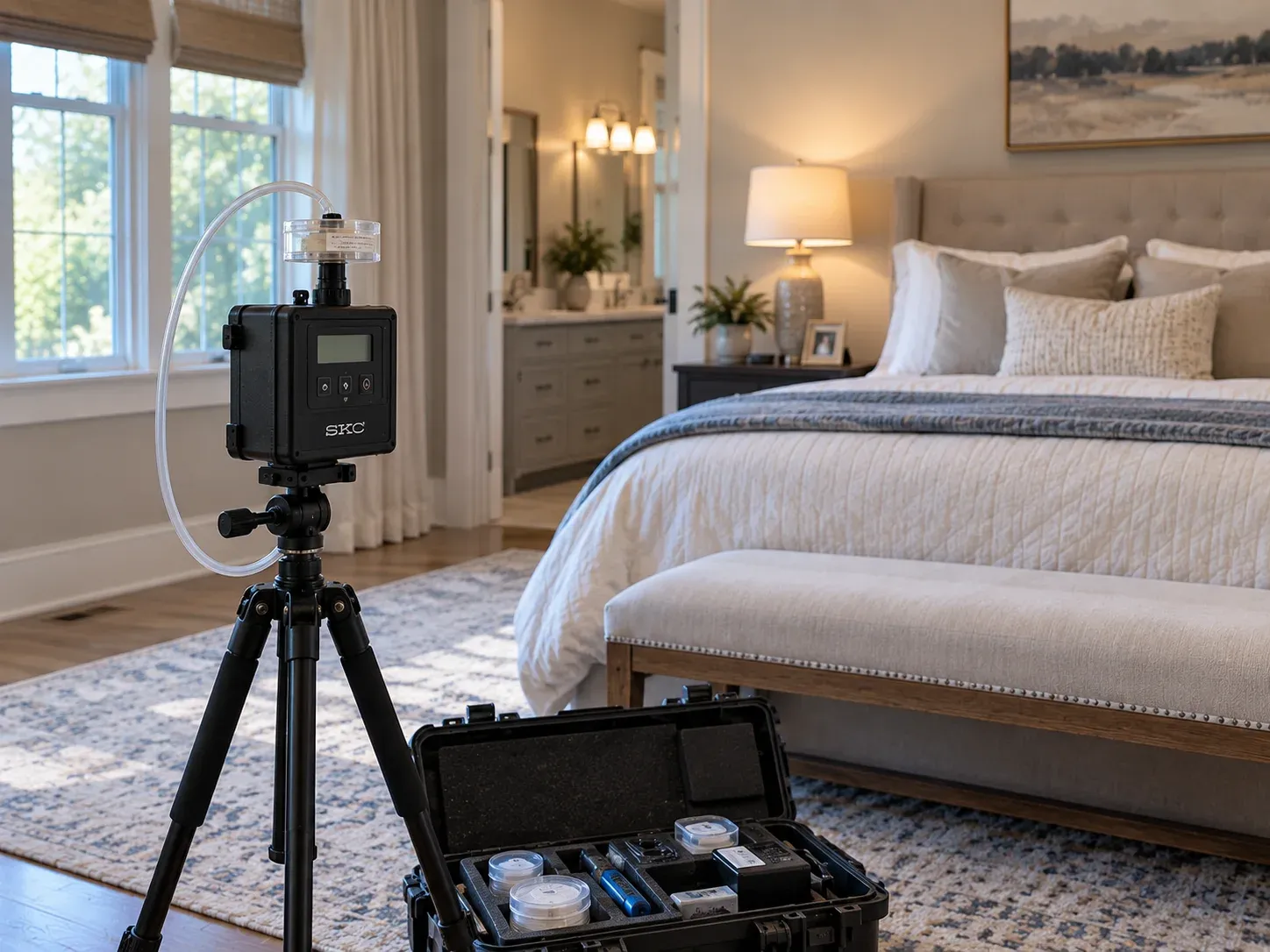
That is the unit most air reports use. The American Industrial Hygiene Association says results are typically reported in spores per cubic meter of air. It works like this: a pump pulls a measured amount of air through a small cassette for a short time, a lab counts what stuck to it under a microscope, and the lab scales the count up to one cubic meter.
NIOSH calls these spore trap samples a five-minute snapshot of what was in the air. The EPA says the same thing in plainer words: air sampling, when properly done, shows what was in the air at the moment the sample was taken. Fungi in the air change with the season, the time of day, and how active people are in the house, according to NIOSH.
So one number from one afternoon is a picture of that afternoon.
Why Did They Sample Outside Too?
The outdoor sample is what gives the indoor numbers meaning. The goal, as the AIHA puts it, is to find out whether any significantly elevated fungal levels are occurring indoors. OSHA says the same thing: compare the levels and types of spores found inside with those found outside.
Health Canada says a concurrent outdoor sample is always required, except in winter when the ground is snow-covered. The EPA, in its guide for schools and commercial buildings, lists a pitfall: outdoor control samples are sometimes omitted. If your report has no outdoor sample, ask why. Without one, the indoor numbers are very hard to read.
What Do the Mold Names on the Report Mean?
Labs usually identify mold only to the genus or group level, which is the first name in a two-part scientific name. The AIHA says direct examination cannot be used for reliable species identification.
A few things to know:
- Aspergillus and Penicillium are grouped. The AIHA says these spores cannot be reliably distinguished from each other under direct examination.
- Spores float outdoors too. The EPA says mold spores float through outdoor and indoor air, which is why the outdoor sample exists.
- The names are clues about materials, not verdicts. Our guide on types of mold notes that Quebec’s public health institute lists Stachybotrys and Chaetomium on wet cellulose materials, like the paper on drywall. Seeing either one together with high moisture readings is worth following up. Seeing a name alone proves very little.
No source we found gives a rank order or a ratio that is normal for every house. If anyone tells you otherwise with a straight face, ask them where it is written.
Is My Number High or Low?
That depends on the comparison, and on the report. Look at three things.
- Indoor against outdoor. If sampling was done after a cleanup, the EPA says the kinds and concentrations of mold indoors should be similar to those found outside. That is one item on the EPA’s list for judging a cleanup finished, next to no visible mold, no mold-damaged materials, and no moldy odor.
- The mix of genera. If the indoor mix is close to the outdoor mix, that is the pattern the EPA expects after a cleanup. If a type shows up indoors that is missing outdoors, ask the inspector what it found.
- What the inspector saw. A number with no moisture and no visible growth means little. A modest number next to a wet wall means more.
Be careful with huge counts. The AIHA says to interpret with caution any laboratory result that reports airborne spore counts greater than 1 million spores per cubic meter. That is a data-quality warning, not a health limit.
Health Canada says considerable expertise is required to correctly interpret air sampling results and that they are normally of limited utility. OSHA says interpretation is best left to the industrial hygienist or other environmental health or safety professional. NYC’s health department says there are no widely accepted guidelines with which to compare results. That is how professionals talk about these reports, and it is a good reason to not trust a report that hands you a verdict from a single column of numbers.
What About Tape Lifts, Swabs, and Dust Tests?
A tape lift presses clear tape against a surface, and a lab examines it under a microscope. ASTM International published a test method for it, and it tells you what is on that surface. It is good for answering the question, is this stain mold? That is the same job we mentioned in the guide on efflorescence vs. mold.
For swabs, we have not found an agency source that explains how to read one, so we will leave that to the lab and the inspector.
ERMI is a DNA-based dust test developed by EPA scientists. The EPA says it does not recommend its routine public use in homes, schools, or other buildings, and that it has not been validated for non-research purposes. Skip it unless a researcher has a specific reason.
How Do You Know the Lab Is Legitimate?
Look for accreditation. The AIHA runs an Environmental Microbiology Laboratory Accreditation Program, called EMLAP, which covers analysis of microorganisms in air, including spore trapping. Accredited labs must also take part in a proficiency testing program. The AIHA keeps a directory of accredited labs, so you can look yours up. The EPA’s testing page says analysis should follow methods recommended by the AIHA.
Ask who collected the sample, how many samples, where they were taken, and whether there was an outdoor control. A report that cannot answer those questions is not worth paying for.
How Do You Know a Cleanup Worked?
Look and smell first. The EPA says that after remediation, visible mold, mold-damaged materials, and moldy odors should not be present. New York City’s health department says surfaces should be left dry and visibly free from mold, dust, and debris. The industry standard, ANSI/IICRC S520, is a procedural standard for remediation, and its current edition describes a post-remediation verification by an independent third party.
Experts disagree on whether to sample after a cleanup. The EPA says surface sampling may be useful, while Wisconsin’s health department generally does not recommend it because of how much mold levels vary. We give you moisture readings before and after and a written scope. If a buyer or lender wants more than that, ask them what they require.
Sources
Checked against these pages in October 2026.
- American Industrial Hygiene Association, FAQs About Spore Trap Air Sampling for Mold and EMLAP accreditation
- NIOSH, Health Hazard Evaluation Report 2003-0039-2914
- Health Canada, Guidance for Indoor Air Quality Professionals
- OSHA, A Brief Guide to Mold in the Workplace
- EPA, Mold Remediation in Schools and Commercial Buildings, Chapter 3, Mold Testing or Sampling, and the ERMI fact sheet
- New York City Department of Health, Guidelines on Assessment and Remediation of Fungi in Indoor Environments
- ASTM International, tape lift test method
- IICRC, ANSI/IICRC S520 and ANSI, S520-2024 overview
- Wisconsin Department of Health Services, Mold FAQ
More Questions About Mold Test Results
What number means my home is dangerous?
None does. NIOSH says there are no standards that relate health effects to a specific level of fungi in the air, and the EPA says no federal limits have been set. The report is a comparison, not a pass or fail.
Why did the lab also test outside?
Because the comparison is the point. The question is whether levels indoors are significantly higher than outdoors, or different in kind. Health Canada says a concurrent outdoor sample is always required, except in winter when the ground is snow-covered.
Does Penicillium or Aspergillus on the report mean it is growing in my walls?
Not by itself. The American Industrial Hygiene Association says these two spores cannot be reliably told apart on a standard air sample, so labs often report them as a group. Spores are also in outdoor air, so it matters what the outdoor sample showed and what the inspector found.
Should I get an ERMI test?
The EPA developed it, and also says it does not recommend routine public use of ERMI in homes, schools, or other buildings. It has been peer reviewed for research purposes and not validated for other uses.
Send It Over. We Will Read It With You.
(267) 828-9088Request an inspection- Started in Gettysburg in 2012
- IICRC AMRT and WRT certified
- 1-year warranty on every job
- Chuck is on the job, not just the phone